
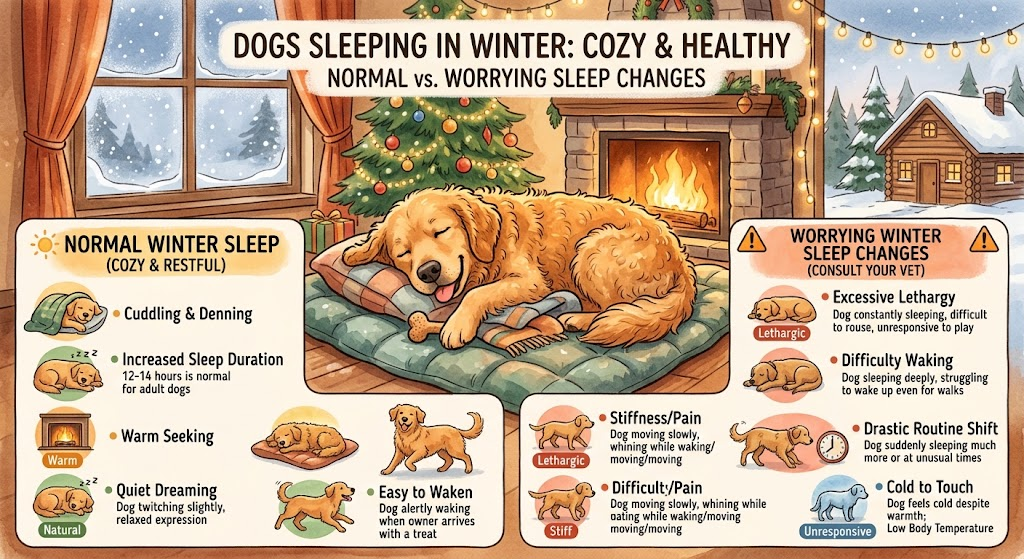
Short answer: Often, yes. Shorter days, colder weather, and less exercise lead many dogs to nap more in winter, and a gradual increase in an otherwise happy, healthy dog is usually normal. The warning sign is not the extra sleep itself. It is sleep that comes with other changes, such as less interest in food or walks, stiffness, weight gain, or a dog that is hard to rouse. A short sleep log tells you which one you are looking at.
Do dogs sleep more when it’s cold?
Many do. Several things push in the same direction:
- Less daylight. Shorter days change routines, and some dogs follow the light by resting more.
- Less activity. Colder, darker walks are shorter, so dogs burn less energy and nap more.
- Staying warm. A dog curled up in a warm spot is conserving energy as well as resting.
- A quieter household. Fewer outings and less to do often means more sleeping.
Sleep needs also depend heavily on age and size. Puppies and senior dogs sleep more than healthy adults, and large breeds often sleep more than small ones. For a personal range based on your dog’s age and size, use the Dog Sleep Calculator rather than a single number from a generic article.
Do dogs sleep more in summer too?
They can. Hot weather also makes dogs rest more, mostly to avoid overheating, so heavy sleeping is not exclusive to winter. If your dog struggles to stay comfortable in warm weather, see do dog cooling mats really work. The difference is the reason. In summer the cause is usually heat, and in winter it is usually low activity and shorter days. If your dog sleeps a lot in both seasons and the pattern keeps growing, look at the dog, not the weather.
Do dogs get seasonal depression?
This is a common question and the honest answer is that the science is limited. Some owners notice a dog that seems lower in energy and mood during the dark months, and shorter days plus less exercise and less social contact can plausibly affect how a dog behaves. But there is no firm evidence that dogs have a condition identical to human seasonal depression.
What matters in practice: if the low energy comes with a loss of interest in food, play, or people, treat it as a health question and talk to your vet, instead of assuming it is just the season.
Normal winter sleep or a problem?
| What you see | Usually means |
|---|---|
| Naps a bit more, wakes happily, eats well, enjoys walks | Likely normal seasonal change |
| Sleeps more but seems stiff, slow to rise, or reluctant on stairs | Possible joint pain. See dog arthritis and cold weather |
| Sleeps more and is gaining weight, with a thinning coat or seeking warmth | Ask your vet about thyroid testing |
| Sleeps more right after the clocks changed | Likely a routine shift. See dogs and daylight savings time |
| Sleeps more and the weight is creeping up | Check portions. See do dogs need more food in winter |
| Hard to wake, wobbly, or unresponsive | Urgent vet visit |
| Sleeps more with vomiting, diarrhea, not eating, or labored breathing | Call your vet the same day |
Sleeping more is a symptom, not a diagnosis. Pain, thyroid disease, infections, heart problems, anemia, and some medications can all make a dog sleep more, and only your vet can tell them apart.
The 2 week sleep log
Most articles say “watch your dog.” A short log is more useful, because sleep changes are easy to miss when they happen slowly. It takes about a minute a day.
Each evening, write down three things:
- Total rest. A rough estimate of daytime naps plus night sleep. It does not need to be exact.
- How easily your dog wakes. Wakes at a sound, wakes at a touch, or hard to wake.
- Energy when awake. Eager for walks and meals, a little slow, or uninterested.
Compare the second week with the first week, and with what you remember from last summer. You are looking for direction, not for a perfect number.
| What the log shows | What to do |
|---|---|
| Stable, with good energy when awake | Nothing to fix. Keep gentle daily exercise |
| Slowly rising total rest, energy still good | Likely seasonal. Add a short walk or play session each day |
| Rising rest plus any dip in energy, appetite, or mobility | Book a vet visit and bring the log |
| Hard to wake on any day | Call your vet right away |
Bring the log to the appointment. It helps your vet far more than “he seems tired lately.”
How to keep a sleepy winter dog healthy
- Keep a small daily dose of activity. Short, regular walks and indoor play protect muscle and mood.
- Watch the scale. More sleep and the same food can mean slow weight gain. Check ribs and waist with the Body Condition Score Checker.
- Give a warm, supportive bed away from drafts, so rest is comfortable and getting up is easy. See how to choose a waterproof orthopedic dog bed before you buy.
- Keep a steady routine. Regular meal and walk times help keep sleep patterns stable.
- Do not wake a healthy, sleeping dog repeatedly to force activity, but do check on one that seems unusually hard to rouse.
For older dogs, the Senior Dog Wellness Check In helps you spot changes in energy, appetite, and behavior that are worth mentioning to your vet.
Can dogs sleep in the cold?
Some can, especially thick coated breeds, but many cannot sleep comfortably outside in cold weather, and small, short coated, young, and senior dogs are the most at risk. If your dog sleeps outdoors or in an unheated space, check the Cold Weather Risk Calculator and read does wind chill affect dogs.
When to call your vet
- Your dog is hard to wake, or seems confused or wobbly after waking
- A sudden, large change in sleep, rather than a gradual one
- Sleeping more together with loss of appetite, vomiting, diarrhea, or labored breathing
- Stiffness, limping, or reluctance to move
- Weight gain, a thinning coat, or constant seeking of warmth
- A sleep change that keeps growing over several weeks
FAQ
Do dogs sleep more in winter?
Many do, because of shorter days, colder weather, and less exercise. A gradual increase in a healthy, happy dog is usually normal.
Do dogs sleep more when it’s cold?
Often, yes. Dogs conserve energy and stay in warm spots, and they are usually less active.
Why do dogs sleep more in the winter?
Less daylight, less activity, and a quieter household. The cause is usually routine, not illness, unless other signs appear.
Do dogs sleep more in the winter time than in summer?
Many do, but hot weather also makes dogs rest more. The reason differs, so compare with your dog’s own baseline.
Do dogs get seasonal depression?
Research is limited and there is no firm proof that dogs have it in the same way people do. A dog with low mood, low appetite, or less interest in play should be checked by a vet.
Can dogs sleep in the cold?
Some thick coated dogs can, but many cannot, and small, young, and senior dogs are at higher risk. Check the cold weather calculator.
How much should my dog sleep?
It depends on age, size, and activity. The Dog Sleep Calculator gives a personal range.
General information, not veterinary advice.