Short answer: Dogs do not understand clocks, but they do notice the change. Their day runs on routine and light, so when the clocks move, their meal, walk, and wake-up cues shift an hour out of sync with yours. Most dogs adjust within a week if you move the schedule in small steps instead of all at once.
In the US, clocks go back one hour on Sunday, November 1, 2026. In the UK and most of Europe, they go back on Sunday, October 25, 2026.
Are dogs affected by daylight savings time?
Mostly through routine, not through the clock itself. A dog that eats at 7:00 a.m. every day will still expect breakfast at the old time, which now feels an hour early on the new clock. You may see:
- Waking you up an hour “early”
- Asking for dinner too soon
- Pacing or restlessness at old walk times
- Needing to go out at unusual hours
Dogs with a very fixed routine tend to notice more than dogs with a flexible one.
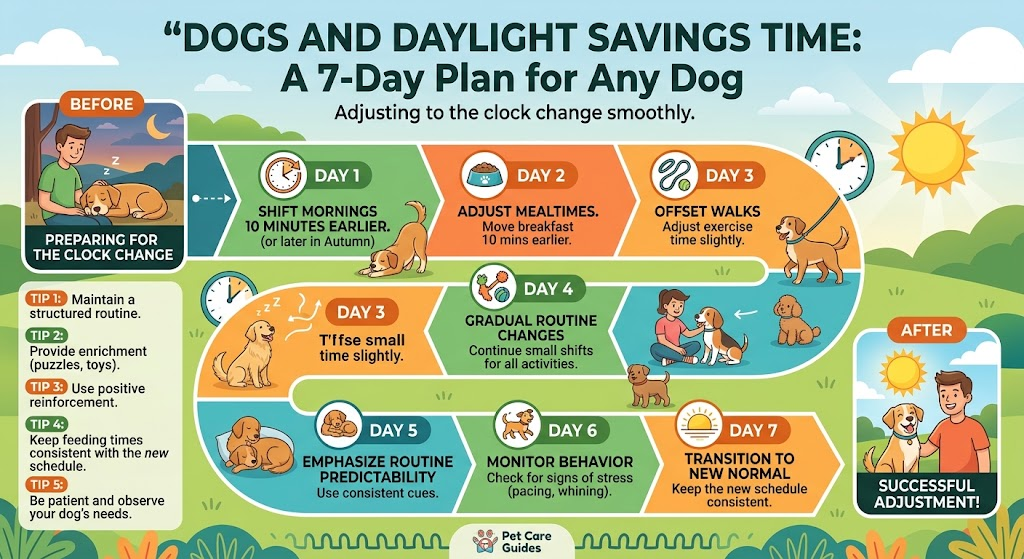
The 7-day schedule shift
The idea is simple: after the clocks change, slide your dog’s day later in small steps until it matches the new clock time. Keep the order of the day the same (wake, potty, walk, breakfast), because order matters as much as the exact time.
| Day | What to do |
|---|---|
| Saturday (day before) | Normal schedule. Optional: shift meals and walks 15 minutes later |
| Sunday (clocks go back) | Feed and walk about 30 minutes later than your old clock time |
| Monday and Tuesday | Move another 15 minutes later |
| Wednesday and Thursday | Move another 15 minutes later |
| Friday | You are back on your usual clock times. Hold steady |
Watch your dog and adjust. A calm dog that sleeps through can move faster. An unsettled dog needs smaller steps.
Adjust the plan for your dog
| Your dog | How to adjust |
|---|---|
| Puppy | Keep potty breaks on a strict schedule. Shift by only 10 minutes a day and expect a few extra accidents |
| Senior dog | Move slowly, over 10 days if needed, and keep comfort and potty access easy |
| Anxious dog | Keep every other cue (bedtime ritual, feeding spot, walk route) identical and change only the time |
| Dog with fixed meds (such as insulin) | Do not shift doses yourself. Ask your vet how to handle the time change |
| Dog that wakes with sunrise | Use blackout curtains or a white-noise machine so earlier light does not wake them |
| Working owner with a fixed commute | Shift the evening walk and meal instead of the morning routine, so the day stays workable |
Do not feed early to stop the begging
When your dog asks for dinner an hour early, giving in teaches them the old time is the new normal. Hold the meal at your planned shifted time, and use a short walk or a puzzle toy to bridge the gap.
Darker evenings are the real safety change
Sunset comes about an hour earlier after the clocks go back, so your usual after-work walk may now be in the dark.
- Add a reflective vest, light-up collar, or clip-on light.
- Keep your dog on a leash in low light.
- Choose well-lit routes.
If the evenings also turn cold, check the Cold Weather Risk Calculator. To confirm your dog still gets enough daily exercise after you reshuffle walks, use the Dog Walking Time Calculator.
FAQ
Do dogs notice daylight savings time?
They notice the change in routine, not the clock itself.
How long does a dog take to adjust to daylight savings time?
Often a few days to a week. Puppies, seniors, and anxious dogs may take longer.
Should I change my dog’s feeding time for daylight savings?
Yes, gradually. Shift by 10 to 15 minutes at a time until it matches the new clock time.
Why is my dog waking me up earlier after the clocks change?
Your dog’s body still follows the old schedule. Keep feeding and walk times steady and the wake-up time will drift later.
Is it bad for dogs when the clocks change?
No. It is a minor disruption that most dogs handle well with a gradual shift.
General information, not veterinary advice.