
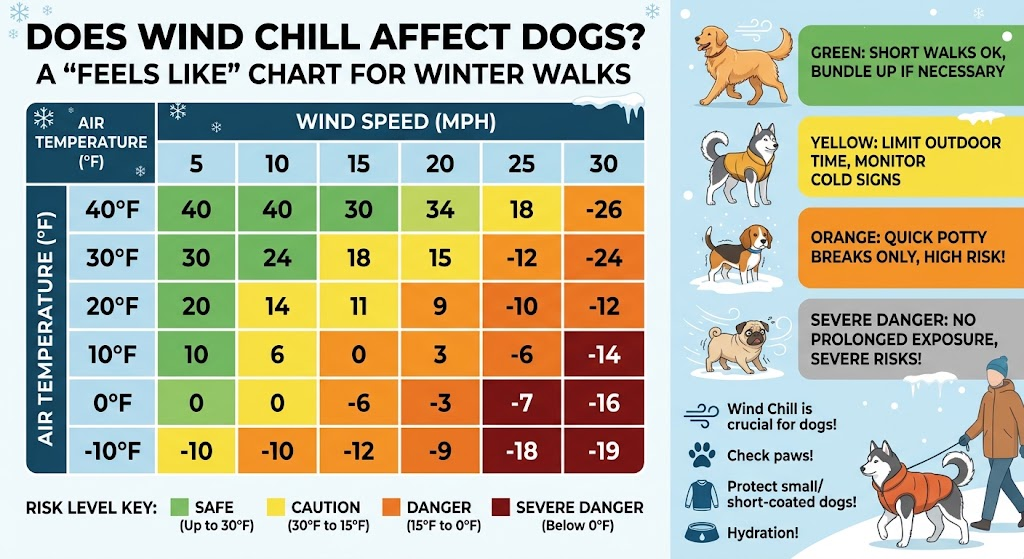
The thermometer says 30°F, so you grab a jacket and head out with your dog. Ten minutes in, your dog is lifting paws, slowing down, and looking at the door. Nothing about the number on your weather app explained why.
The missing piece is usually wind. Moving air strips heat away from the body faster than still air at the same temperature, which is why a calm 30°F day and a breezy 30°F day are two very different walks. Most winter walking advice mentions this in one sentence and moves on. This guide gives you the actual numbers, so you can look up the real “feels like” temperature and match it to your dog.
Do Dogs Feel Wind Chill? The Short Answer
Yes, dogs feel wind chill, though not in exactly the same way people do. Wind pushes through a dog’s coat and breaks up the thin layer of warm air that fur normally traps against the skin, so heat escapes faster than it would on a calm day at the same temperature. Dogs are affected by wind chill across the board, and the effect is strongest in small dogs, short-haired and thin-bodied dogs, puppies, seniors, and dogs with health conditions, and it gets worse when the coat is wet.
Why the Air Temperature Alone Is Misleading
Wind chill is a measure of how fast exposed skin loses heat in moving air. The formula used by the U.S. National Weather Service was built around human skin, not dog coats, so it isn’t a perfect model of what your dog experiences. Fur, body size, and coat condition all change how much heat a dog actually loses.
It is still the most practical shorthand available, and it’s the number most vets and safety guides tell owners to use instead of the raw air temperature. Think of it as a way to tell when a day is colder than it looks, not as an exact measurement of your dog’s body.
Two limits worth knowing. The NWS only defines wind chill when the air is 50°F or colder and the wind is above 3 mph. And wind chill alone doesn’t cause frostbite when the actual air temperature is above freezing, though it can still make a walk miserable for a small or thin-coated dog.
Wind Chill Chart for Dog Walks (°F)
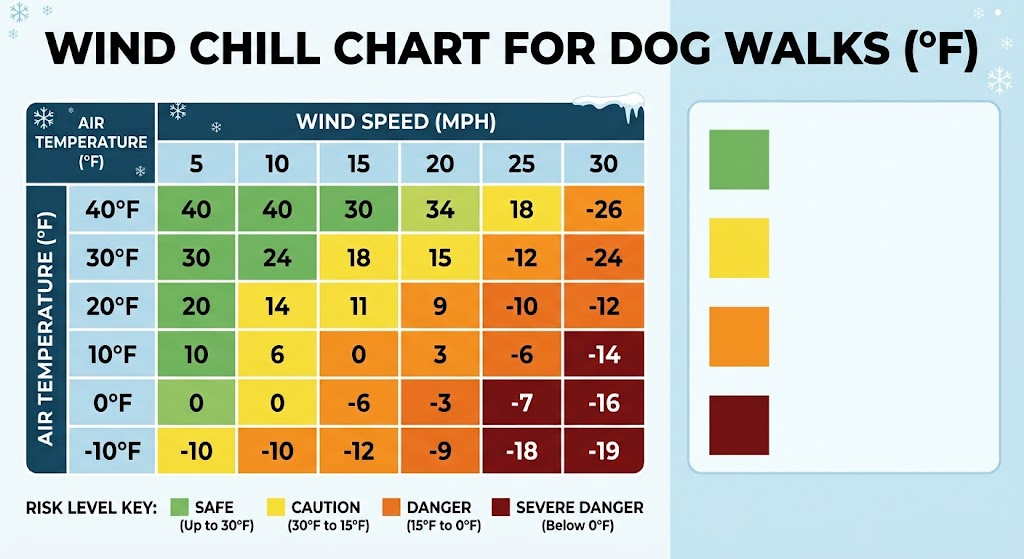
Find the air temperature on the left and the wind speed across the top. The number where they meet is the “feels like” temperature. These values come straight from the NWS wind chill formula.
| Air temp | 5 mph | 10 mph | 15 mph | 20 mph | 25 mph | 30 mph |
|---|---|---|---|---|---|---|
| 40°F | 36°F | 34°F | 32°F | 30°F | 29°F | 28°F |
| 35°F | 31°F | 27°F | 25°F | 24°F | 23°F | 22°F |
| 30°F | 25°F | 21°F | 19°F | 17°F | 16°F | 15°F |
| 25°F | 19°F | 15°F | 13°F | 11°F | 9°F | 8°F |
| 20°F | 13°F | 9°F | 6°F | 4°F | 3°F | 1°F |
| 15°F | 7°F | 3°F | 0°F | -2°F | -4°F | -5°F |
| 10°F | 1°F | -4°F | -7°F | -9°F | -11°F | -12°F |
| 5°F | -5°F | -10°F | -13°F | -15°F | -17°F | -19°F |
| 0°F | -11°F | -16°F | -19°F | -22°F | -24°F | -26°F |
A quick example: it’s 30°F with a 15 mph wind. The chart says it feels like 19°F. For your dog, that’s the number to plan around, not 30.
What to Do With the “Feels Like” Number
Once you have the feels-like temperature, use these general guidelines. They reflect the rules of thumb most veterinary and shelter sources agree on, and they’re a starting point, not a guarantee for any individual dog.
| Feels-like temp | Healthy medium/large dog, thick coat | Small, short-haired, puppy, or senior dog |
|---|---|---|
| Above 45°F | Normal walk | Normal walk, coat optional |
| 32 to 45°F | Normal walk, watch for discomfort | Coat recommended, consider a shorter walk |
| 20 to 32°F | Up to about 30 minutes | About 15 to 20 minutes, coat on |
| 0 to 20°F | Shorter walk, stay alert for cold stress | Potty breaks and very short outings only |
| Below 0°F | Potty breaks only | Potty breaks only, stay close to the door |
If your dog has arthritis, diabetes, kidney problems, or another health condition, treat them as a “small or vulnerable” dog on this chart no matter their size, since health issues make it harder to regulate body temperature.
Cold weather also changes how many calories your dog burns, especially if they spend a lot of time outside. If you’re wondering whether their portions should change this winter, our guide on whether dogs need more food in winter covers when to adjust and when to hold steady.
Conditions That Make a Walk Colder Than the Chart Says
The wind chill number doesn’t capture everything. Two things can make a given feels-like temperature harder on your dog:
- Wet fur. Damp fur loses most of its insulating ability. A dog that’s been walking through slush, sleet, or rain is losing heat much faster than the chart suggests, so shorten the walk and dry your dog thoroughly afterward, including between the toes.
- Ice, snow, and salt. Cold pavement and de-icing salt can bother paws well before the rest of the body feels the cold. If your dog keeps lifting or licking paws, that’s your cue to head home.
Signs Your Dog Is Too Cold, Whatever the Chart Says
Your dog’s behavior is the final word. Shivering, tucking the tail, lifting paws, slowing down, or refusing to keep walking are all signs it’s time to go inside. Hypothermia in dogs begins when body temperature drops below about 99°F, and a dog that seems unusually lethargic, weak, or stiff after cold exposure needs a call to your vet.
Frequently Asked Questions
Does wind chill affect dogs? Yes, in practice. The wind chill formula was designed around human skin, so it isn’t exact for a dog with a fur coat. But wind does pull heat away from a dog’s body faster, especially for small, short-coated, or thin dogs, so the feels-like temperature is a useful guide for deciding how long to stay out.
Do dogs feel wind chill like humans do? They feel the effect, but the numbers aren’t identical. The wind chill formula was built around human skin, while a dog’s fur, size, and body fat change how much heat is lost. That’s why this guide treats the feels-like temperature as a planning guide, not an exact reading of your dog’s body.
Are dogs affected by wind chill? Yes. Wind strips heat from a dog’s body faster than still air at the same temperature, so a windy 30°F day is harder on a dog than a calm one. Small, short-haired, thin, very young, and older dogs are affected the most, and a wet coat makes the effect worse.
Can dogs feel wind chill? Dogs can’t tell you, but their behavior does. Shivering, tucking the tail, lifting paws, slowing down, or trying to turn back toward home are the usual signs that the wind is making a walk uncomfortable.
What wind chill is too cold for dogs? There isn’t one official cutoff that fits every dog. As a general guide, a feels-like temperature in the 20s is where small and vulnerable dogs need a coat and a shorter walk, and below about 0°F most dogs should only go out for potty breaks. Use the chart above to convert the air temperature and wind speed into a feels-like number first.
What wind chill is dangerous for dogs? Risk climbs as the feels-like temperature drops below 0°F, especially for small, short-haired, young, senior, or unwell dogs, and especially if the coat is wet. At that point cold stress, hypothermia, and frostbite on exposed areas like paws, ears, and tail become real concerns, so keep outings brief and call your vet if your dog seems weak, lethargic, or stiff afterward.
Should I use the air temperature or the feels-like temperature for my dog? Use the feels-like temperature on windy days. It gives a better sense of how fast your dog will lose body heat than the raw air temperature does.
How long can I walk my dog when the wind chill is below freezing? Healthy medium and large dogs with thick coats can often manage about 30 minutes when the feels-like temperature is in the 20s, while small or short-haired dogs usually do better with 15 to 20 minutes and a coat. Below about 0°F, most dogs should only go out for potty breaks.
Are some dogs more affected by wind chill than others? Yes. Puppies, senior dogs, small breeds, short-haired and thin-bodied dogs, and dogs with health conditions lose heat more quickly and should be treated more cautiously than a healthy, thick-coated dog of the same weather.
Does a dog coat or sweater help in wind? For small and short-haired dogs, a coat that covers the chest and belly can make a real difference, and a windproof outer layer helps most. It doesn’t replace limiting time outside when the feels-like temperature is very low.
Want a number tailored to your dog instead of a general chart? Try our Dog Cold Weather Risk Calculator, which factors in your dog’s size, coat, and conditions. To plan how much exercise your dog needs on shorter winter days, our Dog Walking Time Calculator can help, and for older dogs our Senior Dog Wellness Check-In covers the age-related changes worth watching in cold weather.