
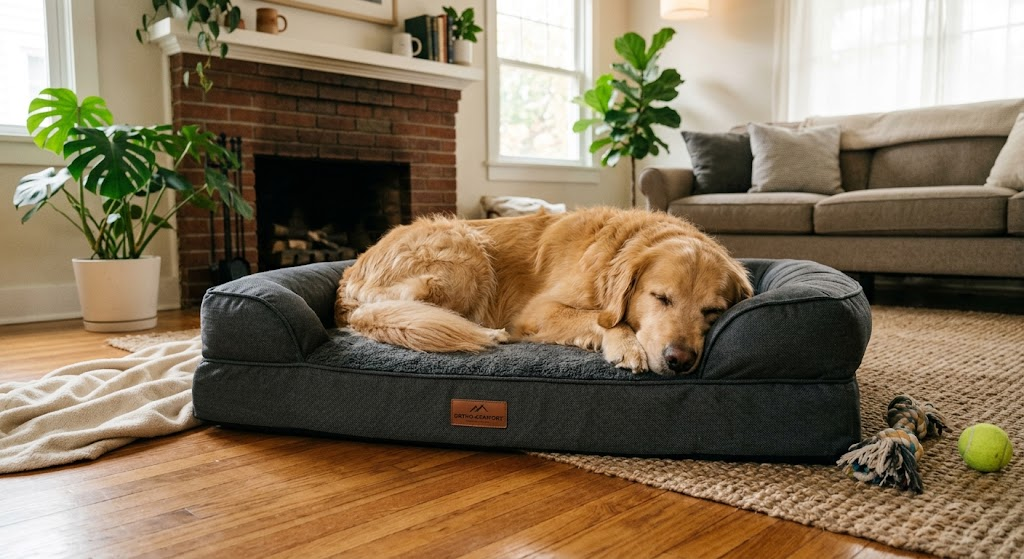
Short answer: A waterproof orthopedic dog bed is worth it for senior dogs, large dogs, dogs with sore joints, and dogs prone to accidents. But the labels on the box prove very little. “Orthopedic” has no standard definition on a bed label, and “waterproof” can mean a fully sealed liner or just a cover that shrugs off splashes. The seven checks below take about five minutes and tell you whether a bed really supports your dog and keeps the foam dry. Dogs spend many hours a day on their beds, so it is worth getting this right.
What “orthopedic” and “waterproof” really mean
These words sell beds, but they are marketing terms. Here is what to expect versus what a label can get away with.
| Label | What it should mean | What it can mean on a box |
|---|---|---|
| Orthopedic | Thick, dense foam that keeps joints off the floor and spreads weight out | Any foam bed, including thin or lumpy foam |
| Memory foam | Slow-recovery foam that molds to the body and springs back | A thin memory foam layer over cheaper base foam |
| Waterproof | A sealed liner around the foam, plus a cover you can remove and wash | A water-resistant cover only, with open zippers and seams |
| Nest or bolster | Raised sides to lean and curl against | Walls so high that a stiff dog has to climb in |
A certification such as CertiPUR-US is a useful sign for the foam’s chemical content and emissions. It says nothing about how supportive the foam is or whether the liner leaks, so you still need to check those two things yourself.
Which dogs benefit most (and who should skip memory foam)
| Dog | Why this kind of bed helps | What to prioritize |
|---|---|---|
| Senior or stiff dogs | Cushioning keeps joints off hard floors and makes getting up easier | Low entry, firm foam, non-slip base. See dog arthritis and cold weather |
| Large and giant breeds | Heavy dogs flatten thin foam quickly | Dense, thick, single-piece foam in a size that fits a full stretch-out |
| Dogs with leaks or recovering from surgery | Accidents soak foam and trap odor | Sealed inner liner, washable cover, and a spare cover |
| Overweight dogs | Extra weight compresses foam faster | Denser foam. Check body condition with the Body Condition Score Checker |
| Hot sleepers and thick-coated dogs | Memory foam can hold warmth | A cooler surface in summer. See do dog cooling mats really work |
| Puppies and heavy chewers | Foam is a hazard if swallowed | Usually skip it until the chewing phase passes. Call your vet if your dog swallows foam |
Dogs also tend to rest more in cold months, as covered in do dogs sleep more in winter, so a bed that felt fine in summer may be doing much more work in winter. To estimate how many hours your dog spends lying down, use the Dog Sleep Calculator.
The 7 checks
Do these in the store, or at home inside the return window. Most take a minute.
| # | Check | How to do it | A good result looks like |
|---|---|---|---|
| 1 | Press test | Press your fist into the center and hold for 5 seconds, then let go. For a big dog, use your whole forearm | The foam gives slowly, you do not feel the floor, and it springs back within a few seconds |
| 2 | Slab test | Lift a corner and press along the edges and corners | One solid piece with no lumps, gaps, or shifting chunks |
| 3 | Liner test | Take the liner off the foam, lay it over a towel, pour a cup of water on it, and wait 10 minutes | The towel stays dry. Look closely at the zipper and seams, because leaks start there |
| 4 | Cover test | Read the care label and open the zipper all the way | The cover comes off completely, is machine washable, and a spare is sold |
| 5 | Entry test | Measure the front wall height and watch how your dog steps in | Your dog walks in without lifting a paw high or hopping. Stiff dogs do best with a low front edge |
| 6 | Size test | Measure your dog stretched out from nose to base of tail and add about 6 inches. For nest beds, measure your dog curled up | The whole dog fits on the foam with no legs hanging onto hard floor |
| 7 | Slide test | Set the bed on your floor and push it with your foot | The base grips. A bed that slides on tile or hardwood is a problem for a stiff dog |
If a bed will also sit in a crate, check the fit with the Crate Size Calculator before you buy.
Thickness is a starting point, not a guarantee. As a rough rule, large dogs usually need 3 to 4 inches of dense foam or more, and small dogs can do well with less. The press test matters more than the number on the box, because a thick bed made of soft foam can still bottom out.
Nest-style beds: cozy, but watch the walls
Nest or bolster beds suit dogs that like to curl up and lean on something. For a stiff or arthritic dog, though, tall walls can be an obstacle at every step in and out. Look for a low front edge, or a flat orthopedic slab with a bolster on only some sides.
Slippery floors matter too. A dog that struggles to get up from a sliding bed will often avoid it, even if the foam is excellent. The arthritis guide covers floor grip and other home changes that make a new bed easier to use.
Checking a specific bed, such as the Cozy Tails nest bed
If you are looking at the Cozy Tails waterproof orthopedic memory foam nest bed, hold its listing up to the table below. A good product page answers every row. If one is missing, ask the seller before you buy.
| Question | Why it matters | Red flag |
|---|---|---|
| How thick is the foam, and is it one solid piece? | Thickness and a solid slab decide whether a heavy dog bottoms out | No thickness listed, or “layers” with no breakdown |
| Is it memory foam throughout, or a thin top layer over base foam? | A thin layer flattens quickly | Vague wording such as “memory foam top” |
| What exactly is waterproof: the liner, the cover, or both? | A sealed liner protects the foam. A water-resistant cover alone does not | “Water resistant” only |
| Are the zipper and seams protected? | Leaks usually start there | No mention at all |
| Is the cover removable and machine washable, and is a spare sold? | You will wash it often | Spot clean only |
| What dog weight does each size fit? | Sizing by weight and stretched-out length avoids guessing | Sizes listed only as S, M, and L |
| How high is the front wall? | Stiff dogs need easy entry | Height not listed |
| What is the return policy? | You need time for the 7 day trial below | Short or no returns on used beds |
For a wider look at what else a dog needs at home, see the Dog Accessories guide, which also explains why a “pet safe” label is a marketing claim rather than proof of testing.
The 7 day bed trial
Many owners buy a bed, see the dog ignore it, and decide it was a waste. A short trial tells you whether this bed suits your dog.
- Days 1 to 2: Place it, do not push. Put the bed where your dog already rests, with a familiar blanket on top. Never force your dog onto it.
- Days 1 to 3: Watch the choice. Does your dog pick it, how long does your dog stay, and does your dog settle faster than before?
- Days 4 to 7: Watch getting up. Rate how your dog rises each morning on the same 0 to 3 scale used in the arthritis guide’s stiffness log, and note any shifting or restlessness.
| What you see | What to do |
|---|---|
| Chooses it, rests longer, rises more easily | It is working. Keep it in the usual resting spot |
| Sniffs it and leaves | Try a different spot, or a lower-sided or cooler bed |
| Pushes the foam aside or stands on the edge | The bed is probably too small or too thin. Use the size and press tests |
| Chews it | Remove it. Foam is not safe for chewers. Call your vet if any was swallowed |
| Stiffness is the same or worse, or limping continues | A bed will not fix this. Book a vet visit and bring your notes |
Keeping the bed clean and knowing when to replace it
- Wash the cover as the care label says, and dry it fully so the zipper area does not stay damp.
- Spot clean the foam and let it air dry completely. Do not put the foam itself in a washing machine.
- Keep a spare cover so there is always a clean one while the other dries.
- Replace the bed when flat spots stay after your dog gets up, the foam no longer springs back, the liner is torn, or an odor stays after cleaning.
When a bed is not enough
An orthopedic bed makes rest more comfortable. It does not treat arthritis or any other condition. Call your vet if you see:
- Sudden or severe limping, yelping, or refusing to put weight on a leg
- Stiffness that lasts more than a couple of weeks or keeps getting worse
- New accidents in a dog that is normally house trained
- Loss of appetite, a change in behavior, or snapping when touched
For older dogs, the Senior Dog Wellness Check In helps you spot changes in energy, appetite, and mobility worth mentioning at the appointment.
FAQ
Is a waterproof dog bed the same as an orthopedic dog bed?
No. Waterproof describes how well the bed resists liquid. Orthopedic describes how well it supports the body. A bed can be one, the other, or both, so check each separately.
How thick should an orthopedic dog bed be?
It depends on your dog’s weight. Many large dogs need 3 to 4 inches of dense foam or more, while small dogs can manage with less. Use the press test rather than relying on thickness alone.
Is memory foam good for dogs?
It can be, especially for senior, large, and stiff dogs, because it spreads weight and cushions joints. It can hold warmth, and it is not a good fit for dogs that chew their beds.
Do dogs with arthritis need an orthopedic bed?
A supportive bed with an easy entry helps many arthritic dogs rest and get up more comfortably, but it does not replace vet care or pain relief.
Can I machine wash a dog bed with memory foam?
Usually only the cover. Spot clean the foam and let it air dry, and always follow the care label.
How do I know when to replace the bed?
Replace it when the foam stays flat after your dog gets up, the liner is damaged, or odor remains after cleaning.
General information, not veterinary advice.