
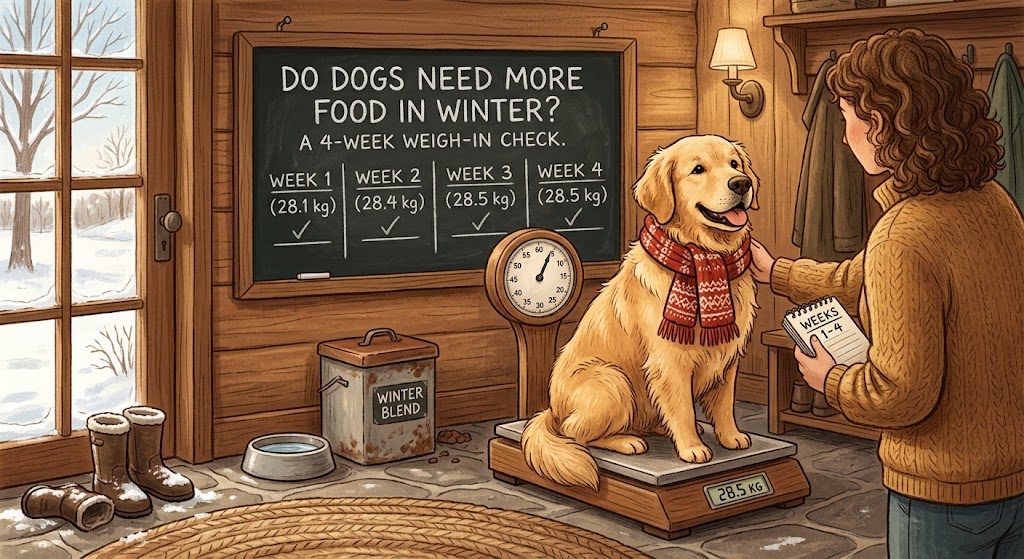
Short answer: Usually not. Most dogs that live indoors and take shorter winter walks need the same amount of food, and some need less. Dogs that spend hours outside in the cold, work, or hike burn extra energy and may need more. Appetite is not the same as need, so let your dog’s weight and body condition decide, not the thermometer.
Do dogs eat more in the winter?
Some do, and some eat less. Cold air raises energy needs a little, because the body spends calories staying warm. Shorter days can also nudge appetite up in some dogs. But a heated home does most of the warming for your dog, and exercise often shrinks in winter because walks get shorter.
The result: appetite goes up, while real calorie burn stays flat or drops. That is why “my dog is hungrier” and “my dog needs more food” are two separate questions.
Which dogs need more, the same, or less
| Your dog | Usual winter need |
|---|---|
| Indoor dog, short potty-and-back walks | Same, sometimes less |
| Indoor dog, walks shortened since summer | Same or slightly less |
| Active dog, long daily walks or runs in the cold | May need a little more |
| Outdoor, working, hiking, or sled-type dog | Often needs more |
| Small, short-coated, or lean dog that shivers | May need a little more, plus a coat |
| Senior dog losing weight | Check with your vet before changing food |
| Overweight dog | Do not add food. Cold weather is not a reason to bulk up |
One myth to drop: fattening a dog up before winter. It rarely helps, and many dogs come out of winter heavier than they went in.
The 4-week winter weigh-in
Instead of guessing, run this check. It takes about a minute per session.
Week 0: set a baseline
- Weigh your dog, using the same scale each time (a home scale with you holding the dog works, or a vet or pet-store scale).
- Run your hands along the ribs. You should feel them under a thin layer of padding without pressing hard, and see a waist from above. The Body Condition Score Checker walks you through it.
- Write down exactly what your dog eats per day, treats included. Measure with a cup or kitchen scale, not by eye.
Weeks 2 and 4: re-check with the same scale, the same ribs-and-waist check, and the same time of day.
Then decide
| What you see | What to do |
|---|---|
| Weight and ribs unchanged | Keep the same amount, even if your dog begs more |
| Ribs easier to see, weight dropping | Increase food by about 10%, then re-check in 2 weeks |
| Ribs harder to feel, waist disappearing | Reduce food slightly and add activity |
| Weight loss continues after two small increases | Book a vet visit to rule out a health cause |
Small steps beat big jumps. For a starting number, the Dog Calorie Calculator gives a baseline, and the scale tells you how to adjust from there.
Do dogs gain weight in winter?
They can, and the cause is usually not the cold. Walks get shorter and darker, the food scoop stays the same, and holiday treats and table scraps pile on. A few extra pounds on a small dog adds up fast.
If your weigh-in shows steady gain, cut the daily amount slightly, count treats as part of the meal, and keep a short daily walk or play session going. If weight loss is the goal and the scale has stopped moving, see why a dog’s weight loss stalls.
Do dogs eat less in winter?
Some do, and a mild dip can be normal. Less activity and a warm house mean lower energy needs, and your dog may simply eat a little less. If weight and ribs look the same, there is nothing to fix.
Look closer if you notice:
- Weight loss or ribs becoming more visible
- Dropping food or chewing on one side (possible dental pain)
- Stiffness or reluctance to stand at the bowl, especially in older dogs
- Vomiting, diarrhea, or low energy
- A change that lasts more than a day or two
Any of these is a reason to call your vet. For older dogs, our Senior Dog Wellness Check-In helps you spot what to mention.
Cold weather diets for dogs: what to change and what to leave alone
Change the amount if the weigh-in says so. Leave most other things alone.
- Keep the same food. There is rarely a need for a special “winter formula.” If you do switch, transition gradually over about a week.
- Measure, do not eyeball. Scoops drift upward over a season.
- Count treats and scraps. Holiday leftovers can add up faster than any cold-weather burn.
- Skip free feeding. A full bowl all day makes it impossible to tell whether your dog needs more.
- Watch water. Dogs can drink less in winter, so keep fresh water available and check the Water Intake Calculator if you are unsure. Feeding wet food? Portion it with the Wet Food Calculator.
- Do not add food instead of a coat. A shivering small dog may need warmth more than calories. Check the Cold Weather Risk Calculator and read does wind chill affect dogs.
When to call your vet
Seasonal appetite changes are normal. These are not:
- Steady weight loss while your dog eats its meals
- Ravenous hunger with increased drinking and urinating
- Very low energy, vomiting, or diarrhea alongside appetite changes
- A senior dog that suddenly eats much less or much more
FAQ
Do dogs need more food in winter?
Most indoor dogs do not. Outdoor, working, and very active dogs often do. Weigh your dog and check ribs every two weeks to be sure.
Do dogs eat more in the winter?
Some do, but eating more does not mean needing more. Check weight before increasing portions.
Do dogs eat less in winter?
Some do, and a small dip is normal if weight and ribs stay the same. Persistent changes need a vet visit.
Do dogs gain weight in winter?
They can, mainly because walks get shorter while portions and treats stay the same.
How much more should I feed my dog in cold weather?
Only if your dog is losing weight: start with about 10% more and re-check in two weeks. If weight is stable, change nothing.
Do dogs need a different diet in cold weather?
Usually the same food, adjusted by amount. Ask your vet before switching a senior, ill, or underweight dog.
General information, not veterinary advice.