
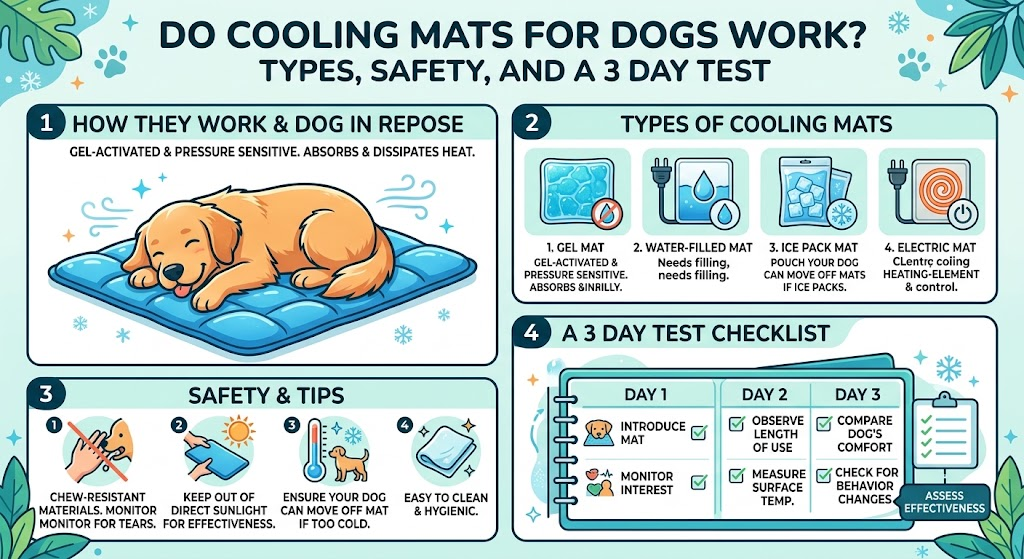
Short answer: Yes, for a limited job. A cooling mat gives your dog a cool surface to lie on, which helps a resting dog shed some heat. It does not lower the temperature of a room, and it cannot treat or prevent heatstroke on its own. How well it works depends on the type of mat, how hot it is, and whether your dog actually uses it, so test before you rely on one.
What a cooling mat can and cannot do
| A cooling mat can | A cooling mat cannot |
|---|---|
| Give a resting dog a cooler surface | Replace shade, air conditioning, or airflow |
| Help in warm rooms, crates, and the back of the car | Make a hot environment safe |
| Give a dog that runs hot a place to settle | Treat an overheated dog |
| Be one part of a plan to keep your dog comfortable | Work forever without recharging or replacing |
Think of it as a comfort tool, not a safety device. If your dog is already struggling in the heat, a mat is not the answer.
The cooling ladder: where a mat fits
Most guides start with the mat. A better order starts with the basics:
- Cooler environment first. Shade, air conditioning, fans, and closed curtains in the hottest hours.
- Water. Fresh water within reach at all times. The Dog Water Intake Calculator gives you a daily target to compare against.
- Smarter timing. Walk early or late. The Dog Walking Time Calculator helps you plan around the heat.
- A cooling mat or cooling bed for rest time.
- Extra gear, such as cooling vests or elevated beds, for dogs that need more help.
The mat is step 4. If steps 1 to 3 are missing, the mat will not fix the problem.
Types of dog cooling mats
| Type | How it cools | Lasts | Best for | Watch out for |
|---|---|---|---|---|
| Pressure activated gel | Absorbs body heat, and cools again after the dog gets off | Often a couple of hours before it warms up | Everyday indoor use | Chewing. Supervise and discard if damaged |
| Water based | Water inside the mat absorbs heat | Varies | Dogs that like a firm, cool surface | Leaks, and the mat can get heavy |
| Ice or freezer based | Uses a frozen sheet or pack | Can be very cold for a while | Dogs that run hot | Some dogs find them too cold and refuse them |
| Cooling fabric or evaporative | Fabric draws heat, and some are wetted | Short | Travel and quick relief | Humid weather reduces the effect |
| Elevated cot with mesh | Air flows under the dog | Does not wear off | Outdoors and long rests | It cools by airflow, not by a cold surface |
Results differ by brand and by climate. Humid weather and very hot rooms reduce what any mat can do.
The 3 day mat test
Many owners buy a mat, see the dog ignore it, and decide mats do not work. A short test tells you whether this mat suits your dog.
- Day 1: Check the surface. After the mat has been set up as the instructions say, put your hand on it for 30 seconds. It should feel cooler than the floor or bed next to it, but not painfully cold.
- Day 1 to 3: Offer, do not force. Place it where your dog already rests. Add a treat or toy on it. Never push your dog onto it.
- Each day, watch three things: does your dog choose it, how long does your dog stay, and does your dog seem calmer or pant less while resting on it?
- Day 3: Decide.
| What you see | What to do |
|---|---|
| Dog chooses it and rests longer on it | It is working. Keep it in the usual resting spot |
| Dog sniffs it and leaves | Try a warmer or cooler type, or a different spot |
| Dog avoids it and pants heavily anyway | The mat is not enough. Fix the environment and talk to your vet |
| Dog chews it | Remove it. Do not use unattended |
Which dogs may benefit
| Dog | Why | Extra caution |
|---|---|---|
| Thick coated dogs | Hold heat longer | Still need shade and water |
| Flat faced dogs (such as bulldogs and pugs) | Higher risk of overheating | A mat is never a replacement for staying cool and out of heat. Ask your vet about your dog |
| Senior dogs | Often struggle with heat. The Senior Dog Wellness Check In helps you note changes | Check the mat is not too cold and is easy to step on |
| Overweight dogs | Heat builds up faster. Check body condition with the Body Condition Score Checker | Ease into activity in heat |
| Dogs in crates or cars | Warm spots are common | Never leave a dog in a parked car. Use the Crate Size Calculator so the mat fits without crowding the crate |
Safety checklist
- Supervise at first, especially with gel or water mats. If your dog chews through the cover, take it away.
- Check for leaks, punctures, and slippery surfaces regularly.
- Wash covers as the maker advises, and dry water based mats fully to avoid mold.
- Do not freeze a mat unless the instructions say so, and follow the instructions for ice based mats.
- Make sure your dog can step off it. A dog that is too cold must be able to leave.
- Call your vet if your dog swallows any part of a mat.
How to choose
- Size: your dog should stretch out fully on it.
- Surface: nonslip underneath and a cover that is easy to clean.
- Durability: thick cover that resists claws and chewing.
- Type: match to your dog’s habits, using the table above.
Sleeping on memory foam? Foam can hold warmth, so a hot sleeper may need a cooler surface on top of it. If your dog is older or has stiff joints, read how to choose a waterproof orthopedic dog bed so the cooling and the support do not cancel each other out.
Browse more gear ideas in the Dog Accessories guide. Do not buy on promises alone. A mat that your dog will not use is a waste, so use the 3 day test.
When a mat is not enough: heatstroke warning signs
Call your vet or an emergency clinic right away if you see:
- Heavy, noisy panting that does not settle
- Thick drooling or a very red tongue or gums
- Vomiting or diarrhea
- Weakness, wobbling, confusion, or collapse
While you get help, move your dog to shade or air conditioning and offer small amounts of cool water. Do not use ice cold water or ice baths. To understand how hot weather affects your dog, use the Dog Heatstroke Risk Calculator.
Dogs also rest more when the weather changes. For how to tell normal resting from a problem, see do dogs sleep more in winter, which also covers hot weather.
FAQ
Do cooling mats for dogs work?
They give a cooler surface for resting and can help a dog that runs hot, but they do not replace shade, water, and airflow, and they cannot treat heatstroke.
Are dog cooling mats safe?
Generally yes when used as directed, but supervise, check for damage, and remove the mat if your dog chews it.
How long does a dog cooling mat stay cool?
It depends on the type and the temperature. Many warm up after a few hours and need time to recover or be recharged.
Will my dog use a cooling mat?
Not always. Offer it where your dog already rests, use treats, and give it a few days. Some dogs prefer a cooler floor or a different type.
Can a cooling mat prevent heatstroke?
No. It is a comfort tool. Heatstroke prevention is about avoiding heat, providing shade and water, and limiting exercise.
Do cooling mats work in a crate or car?
They can add comfort in a crate, but never leave a dog in a parked car, and a mat will not make a hot car safe.
General information, not veterinary advice. If you think your dog is overheating, contact your vet or an emergency clinic right away.