
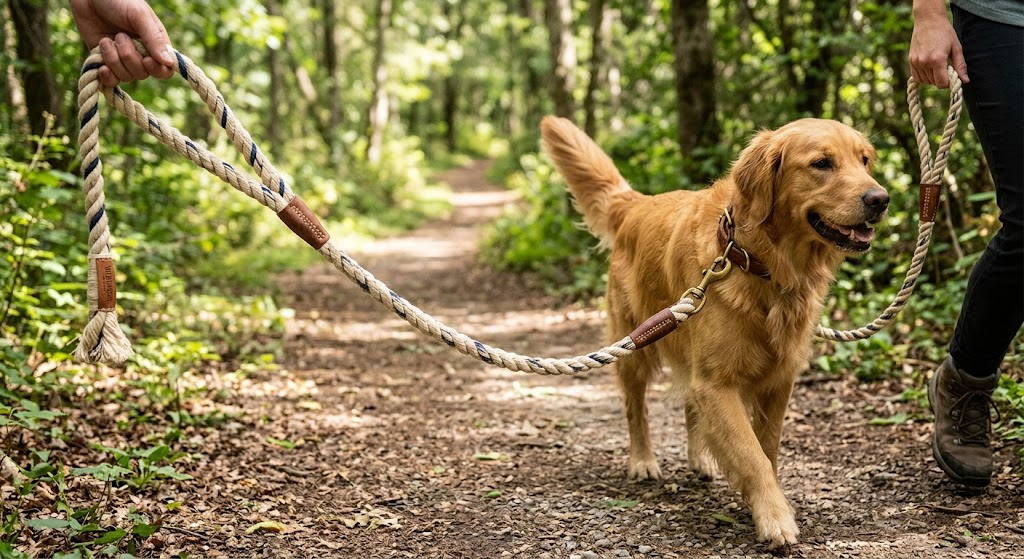
Short answer: A twisted rope dog leash is a good choice for many medium and large dogs because it is durable and easy to grip, but not every rope leash is built well. The things that decide whether one is safe and comfortable are rarely on the front of the package: how the ends are finished, whether the clasp fits your dog’s harness, and how the rope feels in your hand at the end of a long walk. The seven checks below take about five minutes and tell you whether a rope leash is worth your money.
Rope, nylon, or something else?
A twisted rope leash is made from several strands twisted together, usually three, rather than flat webbing sewn in layers. That gives it a rounded, grippy feel and a classic look. It also changes how it wears out, which is why the checks differ from the ones for flat nylon.
| Material | What it is good at | What to watch for |
|---|---|---|
| Cotton rope | Soft in the hand, natural look | Usually hand wash only, slow to dry, and can weaken or smell if left damp |
| Synthetic rope (polyester, nylon, polypropylene) | Tends to be stronger, dries faster, and handles rain and mud better | Can feel stiffer and harder on bare hands, and may fade in strong sun |
| Flat nylon webbing | Light, cheap, easy to find | Can slip through the hand and fray at the edges |
No one material is best for every dog. Match it to where you walk and how your dog pulls.
Which dogs and walks suit a rope leash
| Dog or situation | Rope leash fit | What to know |
|---|---|---|
| Medium to large dogs that walk calmly | Good | Rope is durable and comfortable to hold for long walks |
| Dogs that pull hard | Use with care | Rope can burn or dig into hands. A harness and training matter more than the leash. See the Harness Size Calculator |
| Small dogs | Good, if light | Choose thinner rope and a small, light clasp so the hardware does not weigh the dog down |
| Reactive dogs | Fine, but control comes first | A shorter length and a secure grip matter more than the material. See the Leash Reactivity Trainer |
| Dogs that chew leashes | Poor | Rope is easy to chew through, and swallowed fibers can cause problems. Call your vet if your dog swallows rope |
| Wet, muddy, or beach walks | Synthetic only | Cotton holds water and needs careful drying |
The Dog Accessories guide lists a typical leash budget of $10 to $40, so a premium price does not automatically mean a better rope. Use the checks below instead of the price tag.
The 7 checks
Do these in the store, or at home before the first walk and inside the return window.
| # | Check | How to do it | A good result looks like |
|---|---|---|---|
| 1 | Diameter test | Hold the rope the way you will on a walk for a full minute, then compare its thickness with your dog’s size | It feels comfortable in your hand and in proportion to your dog. Thin cord on a strong dog digs into fingers. Very thick rope on a small dog is heavy and awkward |
| 2 | Construction check | Look closely at the twist and squeeze the rope along its length | A tight, even twist with no loose, fuzzy, or lumpy sections |
| 3 | End check | Inspect both ends: the handle loop and the clasp end. Give each a firm steady tug | Ends are spliced, whipped, or stitched and sealed so nothing can unravel. Avoid ends that look glued or only knotted |
| 4 | Clasp fit test | Clip the leash onto your dog’s collar ring and harness ring before the first walk | The snap closes with a clear click, fits the ring without forcing, and does not twist or jam |
| 5 | Gloved hand test | Slip your hand, in the glove you wear in cold weather, through the handle loop | The loop fits comfortably and does not squeeze or slip off |
| 6 | Length check | Compare the leash length with the places you actually walk | About 4 to 6 feet for sidewalks and training, longer only for open areas where it is allowed |
| 7 | Wear check | Once a month, run the rope through your fingers and test the hardware | No fuzzy frayed strands, no stiff or flat spots, no mildew smell, and the clasp does not wobble |
Why the clasp matters more than most buyers expect. Rope leashes often come with a heavy bolt snap. Buyers sometimes report that a clasp does not fit the ring or buckle on a particular harness, which you only discover at the door. If you are not sure of your dog’s collar ring size, check it with the Collar Size Calculator and the harness hardware with the Harness Size Calculator before you order.
A leash will not fix pulling. If your dog pulls, a rope leash makes it more comfortable for you, not for the dog. Hold the handle with both hands, never wrap the rope around your hand or wrist, and consider a harness that clips at the chest. Rope that slides fast through bare hands can cause a burn.
Checking a specific leash, such as a Pet Passion twisted rope leash
If you are looking at a Pet Passion twisted rope dog leash, hold its listing up to the table below. A good product page answers every row. If one is missing, ask the seller before you buy.
| Question | Why it matters | Red flag |
|---|---|---|
| What is the rope made of, and how thick is it? | Material and thickness decide strength, feel, and care | No material or diameter listed |
| Is a dog weight range or breaking strength stated? | You need to know it suits your dog | “For all breeds” with no limit |
| How are the ends finished? | Unravelling ends are the most common failure | No mention of splicing, whipping, or stitching |
| What clasp is used, and what size? | It must fit your dog’s ring and not be too heavy | Clasp type or size not shown |
| How long is the leash, and how big is the handle loop? | Length and loop size affect control and comfort | Only “standard length” |
| What are the care instructions? | Wet rope can weaken or smell | None given |
| What is the return policy? | You need time to test the clasp and feel | No returns on used leashes |
Keeping a rope leash in good shape
- Rinse off mud and salt water and let the rope dry fully before you coil it.
- Follow the care label. Cotton rope usually needs hand washing, while synthetic rope often copes with a gentle wash.
- Store it dry, off the floor, so it does not stay damp or get chewed.
- Replace it right away when you see frayed strands, a stiff or flattened section, a bad smell that will not wash out, or a loose or cracked clasp. A leash is safety equipment, and a damaged one can fail at the worst moment.
The Dog Accessories guide gives the same monthly check for leashes, harnesses, and collars. For longer walks, plan your routine with the Dog Walking Time Calculator, because a comfortable handle matters more the longer you are out.
FAQ
Are rope leashes good for dogs that pull?
They are strong, but they are not a fix. Rope can burn or dig into your hands when a dog pulls hard. A well-fitted harness and loose-leash training do more than any leash material.
Is a rope leash better than a nylon leash?
Neither is better for every dog. Rope is rounder, grippier, and often more durable, while flat nylon is lighter and cheaper. Choose by your dog’s size, how it walks, and where you walk.
What diameter should a rope leash be?
Many rope leashes for small dogs run around 1/4 to 3/8 inch, and many for large dogs around 1/2 inch or thicker. These are rough starting points, not standards, so check the listing for a stated weight range or breaking strength and test the grip in your own hand.
Can I machine wash a rope leash?
Only if the care label says so. Cotton rope usually needs hand washing, and the metal clasp can wear the rope in a machine.
How often should I replace a rope leash?
There is no fixed schedule. Check it monthly and replace it as soon as you see fraying, stiff spots, a smell that will not wash out, or a clasp that wobbles.
Are rope leashes safe for puppies?
Only with supervision. Puppies chew, and rope is easy to bite through. If your puppy chews the leash, switch to a chew-resistant option and call your vet if any rope was swallowed.
General information, not veterinary or training advice.