
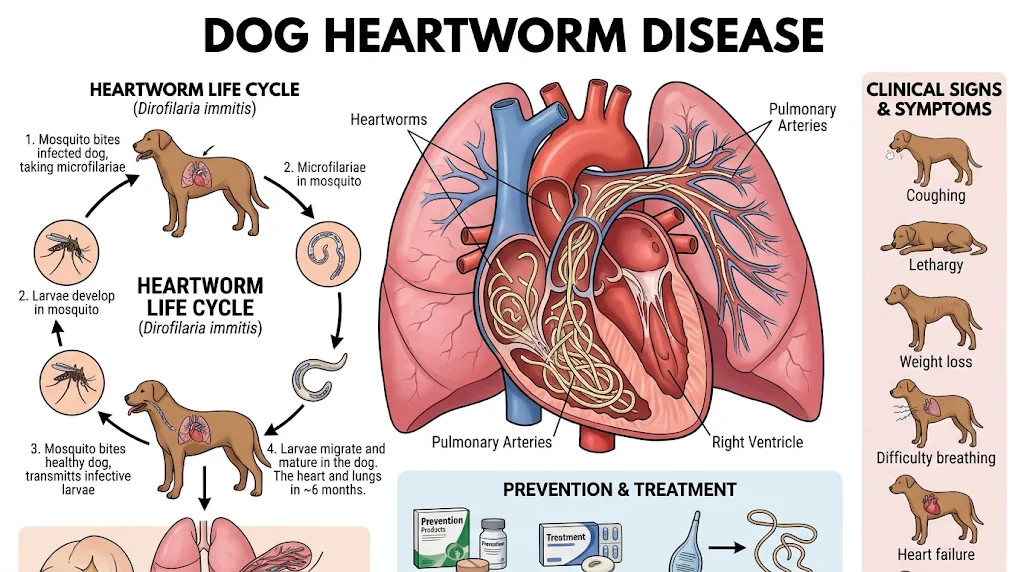
Short answer: Heartworm disease is a serious illness caused by worms that live in a dog’s heart and lungs. Dogs get it from the bite of an infected mosquito. It cannot spread directly from dog to dog. It is also one of the most preventable diseases dogs face, and a monthly preventive is far easier on your dog (and your wallet) than treatment.
This guide explains how dogs get heartworm, what to watch for, how vets test and treat it, and what to do if you miss a dose.
What Is Heartworm Disease?
Heartworm disease is caused by a parasite called Dirofilaria immitis. Adult worms settle in the heart and the large blood vessels of the lungs. They can grow to roughly a foot long, and a dog can carry dozens at once. Over time they damage the vessels, strain the heart, and can lead to heart failure and lasting lung damage.
The disease has been found in all 50 US states. Risk is highest in warm, humid areas along the Gulf Coast and the Southeast, but it is not limited to those places. Wherever mosquitoes live, the risk exists.
How Can Dogs Get Heartworm?
Dogs get heartworm in a few steps, and a mosquito is always involved:
- A mosquito bites an infected animal (dogs, coyotes, foxes, and other wild canines can carry it) and picks up tiny baby worms called microfilariae.
- Inside the mosquito, those larvae develop for about two weeks and become infective.
- The mosquito bites your dog and passes the larvae through the skin.
- Over the next several months, the larvae travel through the body and grow. They reach the heart and lungs and mature into adult worms, usually in about 6 months.
- Adult worms mate and produce more microfilariae, so the cycle can continue if another mosquito bites.
A dog sitting next to an infected dog cannot catch heartworm from it. Without a mosquito, the cycle does not work. That also means your dog does not need to be outdoors much to be at risk. A single mosquito that gets inside the house is enough.
Infection Timeline: Why a Negative Test Can Be Misleading
One of the most confusing parts of heartworm is timing. A dog can be infected and still test negative, because the standard test detects proteins from adult female worms, and those take months to appear.
| Time after the bite | What is happening | What the test shows |
|---|---|---|
| Days 0 to 14 | Larvae are developing in the skin and muscle | Negative |
| Months 1 to 5 | Larvae are migrating and growing toward the heart | Usually negative |
| About 6 months | Worms are mature and reproducing | Usually positive |
| 6 to 12 months and beyond | Worm numbers and damage build up | Positive, and symptoms may appear |
This is why vets test annually even for dogs on prevention, and why a young puppy is often tested again after the first several months. It is also why a dog who missed doses may need a follow up test, not just a restart of the medication.
Signs of Heartworm in Dogs
Early heartworm often looks like nothing at all. Many dogs show no signs for months. When signs appear, they usually grow slowly.
| Stage | What you may notice at home |
|---|---|
| Early | Usually no signs. Some dogs have an occasional mild cough. |
| Moderate | Persistent dry cough, tiring quickly on walks, less interest in play |
| Advanced | Labored breathing, weight loss, poor appetite, a swollen belly from fluid, reluctance to move |
| Severe (caval syndrome) | Sudden collapse, pale gums, dark urine, weakness. This is an emergency. |
If your dog has a cough, it can be tricky to tell the cause. Heartworm cough tends to be dry and ongoing, and it often goes with fatigue after exercise. Our guide on dog coughing and gagging covers the other common causes, so you can compare what you are seeing.
How Do You Tell If Your Dog Has Heartworms?
You cannot be sure from symptoms alone. A vet confirms heartworm with testing:
- Antigen test. A small blood sample checks for proteins released by adult female worms. It is quick and often done in the clinic.
- Microfilariae test. A second blood test looks for baby worms in the bloodstream. Vets often run it with the antigen test.
- Follow up imaging. If the test is positive, your vet may order chest X rays, an ultrasound, or lab work to see how much damage is present.
Your vet will usually repeat a positive result with a second type of test before starting treatment.
Heartworm Prevention for Dogs
Prevention is the best route. Preventives are prescription products that kill larvae before they grow into adult worms. Most are given monthly, and your vet will choose one based on your dog’s age, weight, and health. Common options include:
- Chewable tablets, given once a month
- Topical liquids, applied to the skin once a month
- Injectable preventives, given by a vet every 6 or 12 months in some products
Many of these also protect against intestinal worms, and some add flea or tick coverage. The right choice depends on your dog and where you live.
Why year round matters. In many parts of the US, mosquitoes do not completely disappear in winter. Warm spells, heated garages, and indoor mosquitoes can all keep the cycle going. Preventives also work by killing larvae that entered the body in the past month or so, so a gap in cold months can leave a gap in protection. Most vets and veterinary groups recommend giving it every month, all year.
Starting early helps. Our puppy shots schedule is a good place to line up preventive timing alongside vaccines.
Missed a Dose? Here Is What to Do
This is general guidance, so follow your vet’s specific advice.
- Give the missed dose as soon as you remember. Do not double up on the next dose unless your vet tells you to.
- Call your vet. Tell them how late the dose was.
- Ask about a test. If the gap was long (often more than a couple of months), many vets will want to test your dog before restarting, and then test again about 6 months later. That is because larvae from the gap can take that long to show up.
- Get back on schedule. Set a phone reminder or tie the dose to a regular day, like the first of each month.
How Is Heartworm Treated?
Treatment is possible but demanding. It is generally a multi month process that your vet will plan around your dog’s stage of disease.
- Stabilizing first. Dogs with advanced disease may need medication to support the heart or lungs before the main treatment starts.
- Killing the worms. Vets typically use an antibiotic (to weaken the worms and reduce certain bacteria that live inside them) followed by injections of a drug that kills adult worms.
- Strict rest. This is the hardest part. As worms die, pieces can travel to the lungs and cause blockages. Exercise raises that risk. Many dogs need to be kept quiet and on a leash for weeks or months, with no running, jumping, or rough play.
- Follow up tests. Your vet will retest several months later to confirm the worms are gone.
Treatment carries some risk and usually costs far more than prevention. Dogs that already have severe damage may not fully recover, even if the worms are eliminated.
Because rest matters so much during treatment, your vet may give exact limits for walks. If you are balancing activity for a recovering dog, the dog walking time calculator is a useful baseline for a healthy dog, but always follow your vet’s restrictions first.
Heartworm Costs: Prevention vs Treatment
Prevention is a small, predictable monthly expense. Treatment involves diagnostic tests, multiple medications, injections, follow up visits, and weeks or months of restricted activity, and it often costs many times more. Prices vary a lot by region and clinic. For a quick range, use the dog vet cost estimator. If you are weighing coverage, check what a plan might offer with the dog insurance cost calculator, and read the policy carefully, since many plans exclude preventable or pre existing conditions.
Who Is at Higher Risk?
- Dogs that spend a lot of time outdoors, especially at dusk and dawn
- Dogs in areas with standing water and warm, humid weather
- Dogs not on consistent preventive
- Dogs that recently moved, traveled, or were adopted from a shelter or rescue
- Senior dogs. Older dogs can miss their annual test, so a routine wellness visit is a good time to catch it. Our senior dog wellness check in can help you track what to ask about.
How Heartworm Affects Life Expectancy
Untreated heartworm shortens lives because of the long term damage to the heart and lungs. Caught early and treated successfully, many dogs go on to have a normal lifespan. If you are curious about how health factors play into a dog’s lifespan, try the dog life expectancy calculator.
FAQ
Can dogs get heartworm from other dogs?
No. Heartworm needs a mosquito to move from one dog to another. Dogs cannot pass it directly through contact.
How can dogs get heartworm if they stay inside?
Mosquitoes can get indoors. An indoor dog is at lower risk than an outdoor dog, but still at risk.
What are the first signs of heartworm in dogs?
Often there are none. When signs start, a mild dry cough and getting tired quickly on walks are common.
How long does it take for heartworm to show up on a test?
Usually about 6 months after infection, which is why timing of tests matters.
Can heartworm be cured?
In many dogs, yes, with veterinary treatment. The earlier it is caught, the better the outlook. Advanced disease can leave permanent damage.
Do dogs need heartworm prevention all year?
Most veterinary groups recommend it, since mosquito activity can continue outside the warmest months.
Can puppies take heartworm prevention?
Yes. Many preventives can be started at a young age. Your vet will choose a product based on your puppy’s age and weight.
Can people get heartworm from dogs?
Rarely, and only through a mosquito bite, not from dogs directly. Human cases are very uncommon.
Final Word
Heartworm is dangerous, but it is also one of the most preventable problems in dog care. Keep your dog on a monthly preventive all year, schedule an annual test, and act quickly if you miss a dose. If you notice a lasting cough, tiring easily, or weight loss, make a vet appointment rather than waiting.