
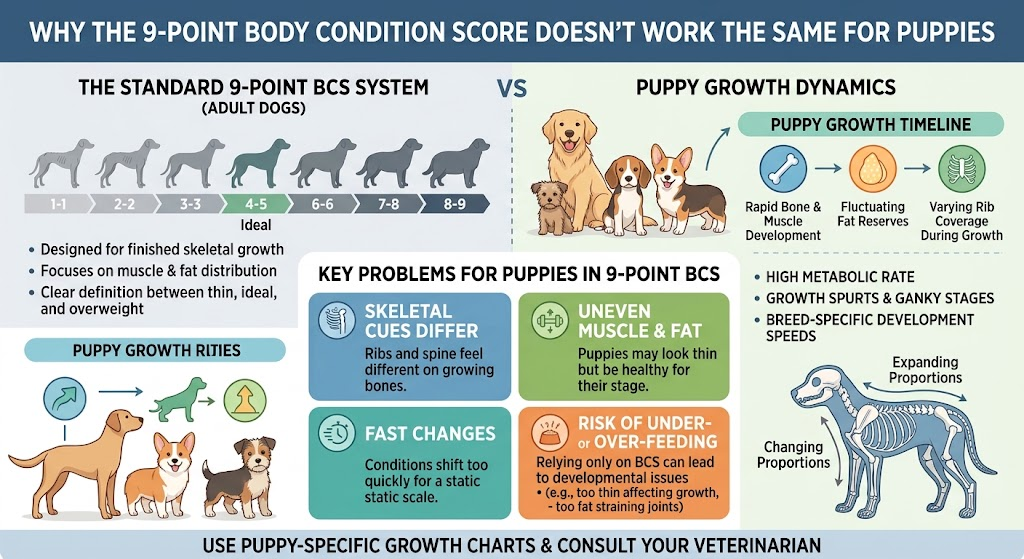
You’ve probably seen the standard dog Body Condition Score (BCS) chart, the one that runs from 1 (emaciated) to 9 (severely obese), with 4-5 marked as “ideal.” It’s a solid tool. Vets use it, and if your dog is full-grown, it’s one of the best ways to tell whether they’re carrying too much fat or not enough.
But if you’ve tried running your hands over your puppy and comparing what you feel to that same chart, you’ve probably ended up more confused than when you started. Maybe their belly looks round after dinner, but you can also feel their ribs pretty easily. Maybe they went from looking a little chubby at 10 weeks to looking almost bony at 5 months, without any change in how much you’re feeding them.
Here’s the thing nobody tells you: the standard BCS chart was built and validated on adult dogs. A growing puppy’s body doesn’t map onto it cleanly, because a puppy isn’t just “a small dog.” It’s a body actively building bone, muscle, and organs, with fat playing a very different role than it does in an adult. Applying the adult chart too literally can lead you to either panic over completely normal growth, or miss something that actually needs attention.
Let’s break down what’s actually going on.
What Body Condition Score Actually Measures (And Why It’s Different in a Growing Body)
At its core, BCS is a hands-on way to estimate how much fat is covering a dog’s frame: you feel the ribs, look at the waist from above, and check for a tuck in the belly from the side. That mechanic works on a puppy too, technically. You can still feel ribs and look for a waistline.
The problem is what those signals mean. In an adult dog, fat cover is the main variable changing. Bones and muscle mass are basically stable, so if you feel less rib and see less waist, it’s almost always fat. In a puppy, bone length, joint size, and muscle mass are all changing week to week, sometimes faster than fat is. A lanky growth spurt can make ribs more visible without any fat being lost. A short “filling out” stretch can round out the belly without any fat being gained.
This is why the best practice for puppies isn’t to rely on BCS alone. It’s to pair a body condition check with tracking their weight trend over time against a growth curve, rather than treating one BCS snapshot as the whole picture. A single BCS reading tells you what a puppy looks like today. A weight trend tells you whether they’re growing on a healthy trajectory.
3 Growth Phases That Can Fool a Standard BCS Check
Puppies don’t grow in a straight line, and each stage can throw off a standard body condition read in a different way.
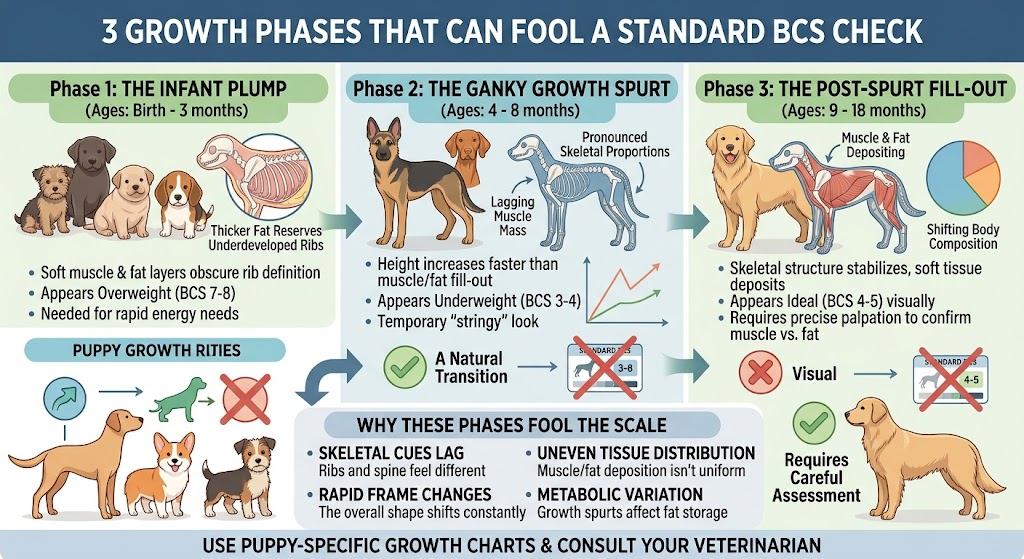
The “Chubby Baby” Phase (8–16 weeks)
Young puppies often carry a softer, rounder look: a bit of a pot belly, chubby cheeks, thicker limbs relative to their frame. This is completely normal. Puppy fat at this age supports rapid brain and organ development, and restricting food because a puppy “looks a little chubby” at 10-12 weeks can actually interfere with healthy growth. Unless your vet has flagged an issue, a round puppy belly at this age is rarely a red flag on its own.
The “Gangly Teenager” Lean Phase (4–8 months)
This is the stage that causes the most false alarms. Somewhere between 4 and 8 months (timing varies a lot by breed size), puppies often go through a lean, leggy phase: ribs more visible, waist more pronounced, sometimes looking almost too thin compared to how they looked a couple months earlier. Owners frequently compare this to the adult BCS chart, land on a 2 or 3, and assume their puppy is underweight.
In most cases, this is just a normal growth spurt where height and frame are outpacing fat and muscle gain. As long as energy levels are normal, appetite is intact, and weight is still trending upward over time (even if body shape looks leaner), this phase usually resolves on its own as the puppy fills back out.
The “Filling Out” Phase (Approaching Adult Size)
As a puppy gets closer to their adult height and weight, their proportions start to look more like a fully grown dog. Muscle mass catches up, the lean gangly look softens, and body shape stabilizes. This is roughly when the standard adult BCS chart starts becoming a reasonably accurate tool again.
When Does the Standard Adult BCS Chart Start Applying?
A useful rule of thumb: once a puppy has reached somewhere around 80-90% of their expected adult height and weight, their body proportions are close enough to an adult’s that the standard 1-9 BCS chart becomes meaningfully accurate again.
The tricky part is that this milestone lands at very different ages depending on breed size. Small breeds often approach adult size well before their first birthday, while giant breeds can still be visibly “filling out” well past 12-18 months. If you’re not sure where your puppy falls on that curve, our Puppy Size Predictor can give you an estimate of their expected adult weight based on their current age, weight, and breed, which makes it a lot easier to judge which growth phase they’re likely in.
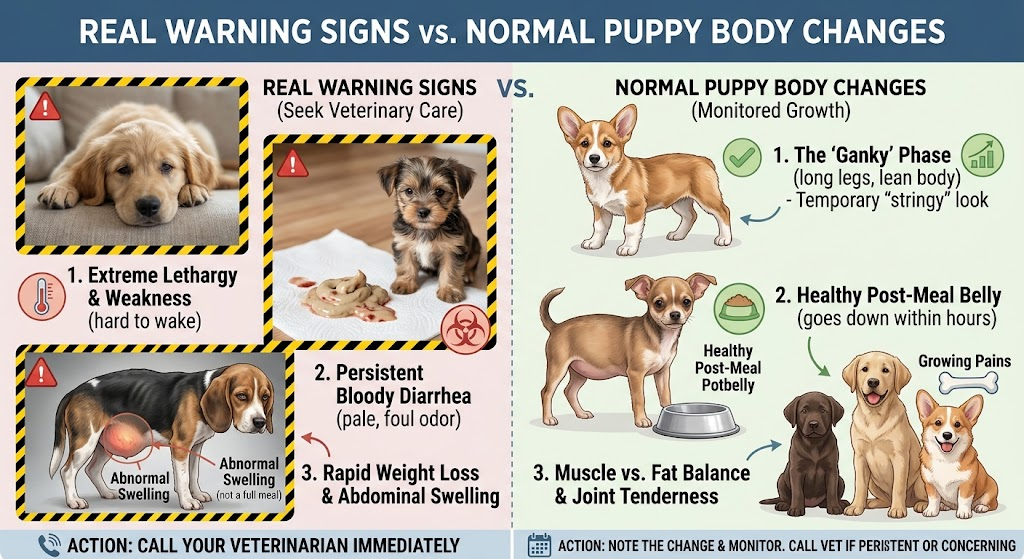
Real Warning Signs vs. Normal Puppy Body Changes
Not every “concerning” thing you notice is actually a problem, but some things genuinely are. Here’s a quick way to tell the difference:
| What You’re Seeing | Usually Normal Growth | Actually Worth a Vet Call |
|---|---|---|
| Round belly after meals | Common in puppies under 4 months | Belly is hard, swollen, or painful to the touch |
| Ribs more visible during a growth spurt (4-8 months) | Common, especially with normal energy/appetite | Ribs, hips, and spine all visible together, plus low energy |
| Weight gain that isn’t perfectly steady week to week | Normal, puppy growth isn’t linear | Sudden weight loss, or weight completely flat for several weeks |
| Slightly different body shape than littermates | Normal, individual growth timing varies | Visible lethargy, vomiting, diarrhea, or appetite loss alongside body changes |
If anything in the right-hand column applies, that’s a conversation for your vet, not something to try to diagnose from a chart alone.
How to Actually Check Your Puppy’s Condition (Step-by-Step)
- Feel the ribs. In a healthy puppy, ribs should feel roughly like the back of your hand, easy to feel with light pressure, not sharply poking out (like knuckles) and not buried under a thick layer (like your palm).
- Watch energy and coat, not just shape. A puppy with a lean phase but a shiny coat, normal energy, and a healthy appetite is very likely fine. A dull coat or low energy alongside body changes is a more reliable warning sign than shape alone.
- Track weight weekly, and look at the trend, not a single number. One low or high reading means very little on its own. A flattening or dropping trend over several weeks is what actually matters.
- Compare against a growth curve, not the adult BCS chart, until your puppy is close to adult size. Once they’ve hit that 80-90% mark mentioned above, the standard chart becomes a much more reliable tool again.
Frequently Asked Questions
Is it normal for my puppy to have a round belly? Yes, especially under 4 months old. A soft, round belly after meals is common and usually not a sign of overweight, unless it’s hard, swollen, or your puppy seems uncomfortable, in which case it’s worth a vet check.
My puppy’s ribs are showing, is that underweight? Not necessarily. Many puppies go through a lean, leggy phase between roughly 4 and 8 months where ribs become more visible simply because their frame is growing faster than their fat and muscle. As long as energy and appetite are normal, this is often just a temporary growth stage.
When can I start using a normal dog BCS chart on my puppy? Once your puppy has reached roughly 80-90% of their expected adult weight and height, their proportions are close enough to an adult dog’s that the standard 1-9 chart starts being meaningfully accurate. This timing varies significantly by breed size.
How often should I check my puppy’s body condition? A quick check every couple of weeks is plenty for most puppies, more frequent than that and you’re likely to overreact to normal, short-term fluctuations rather than tracking the bigger trend.
Should I restrict my puppy’s food if they look a little chubby? Not without talking to your vet first. Restricting calories during key growth periods, especially under 4-6 months, can interfere with healthy development. If you’re concerned, get your vet’s input rather than cutting portions on your own.
Want to check where your puppy’s current weight and body condition stand? Try our Body Condition Score Checker, or use our Puppy Size Predictor to estimate how big they’ll be as an adult. Once your puppy reaches adulthood, our Dog Age Calculator can help you keep track of their life stage going forward. Don’t forget to also keep track of upcoming vaccine milestones and developmental stages along the way.