You download a dog whistle app, tap the button, hear nothing yourself (which seems like a good sign), and wait to see if your dog reacts. Sometimes they perk up their ears. Sometimes nothing happens at all. The app reviews are a mixed bag for exactly this reason: some owners swear it works, others say their dog never responds.
Most explanations stop at “dogs can hear higher frequencies than humans, and this app plays one of those frequencies.” That’s true, but it skips the part that actually explains the inconsistent results: whether your phone’s speaker can cleanly produce that frequency in the first place.
What a Real Dog Whistle Actually Does
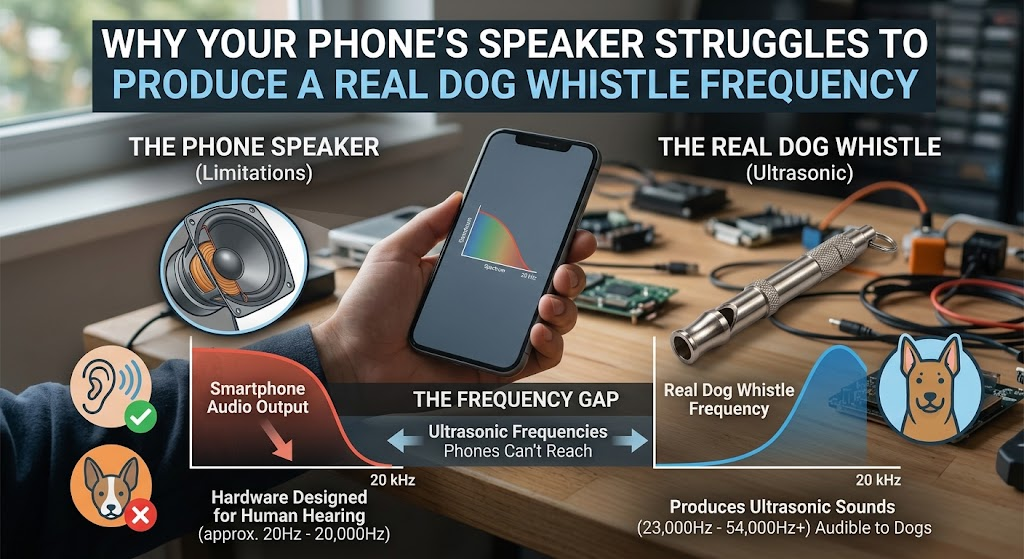
A physical dog whistle, the Galton-style whistle most commonly sold for training, is purpose-built to produce a clean, loud tone somewhere in the range of roughly 23 to 54 kHz, well above the upper limit of human hearing (around 20 kHz for a young person, often lower by adulthood). The whistle’s shape and air chamber are specifically engineered to resonate at that frequency efficiently, producing a strong, consistent tone with very little effort.
A dog’s hearing range extends up to somewhere around 45 kHz, sometimes cited higher depending on the study, so a real whistle sits comfortably within range for most of its output.
Where Phone Speakers Actually Fall Short
A smartphone speaker is a different kind of device entirely. It’s a tiny, general-purpose diaphragm engineered primarily to reproduce the human speech and music range, roughly 250 Hz to 6,000 Hz, with everything above that being a secondary consideration in the design.
Independent frequency response testing on smartphones (research measuring actual output rather than spec sheet claims) shows that most consumer phone speakers start rolling off sharply somewhere around 19 to 20 kHz, with usable output becoming inconsistent beyond that point. A smaller number of devices can push output up toward 23 to 24 kHz under good conditions, but even then, sound pressure level in that range can vary by as much as 15 dB depending on the exact frequency, meaning the volume isn’t flat or reliable the way a purpose-built whistle’s output is.
Put simply: a phone speaker’s practical ceiling sits right around where a real dog whistle’s range begins, not comfortably within it. Most dog whistle apps are playing a tone at 20 to 23 kHz or so, which does fall within a dog’s hearing range, but it’s operating at the very edge of what the hardware can cleanly produce, often at reduced volume and with more distortion than a resonant whistle designed specifically for that job.
Why Some Dogs Still React and Others Don’t
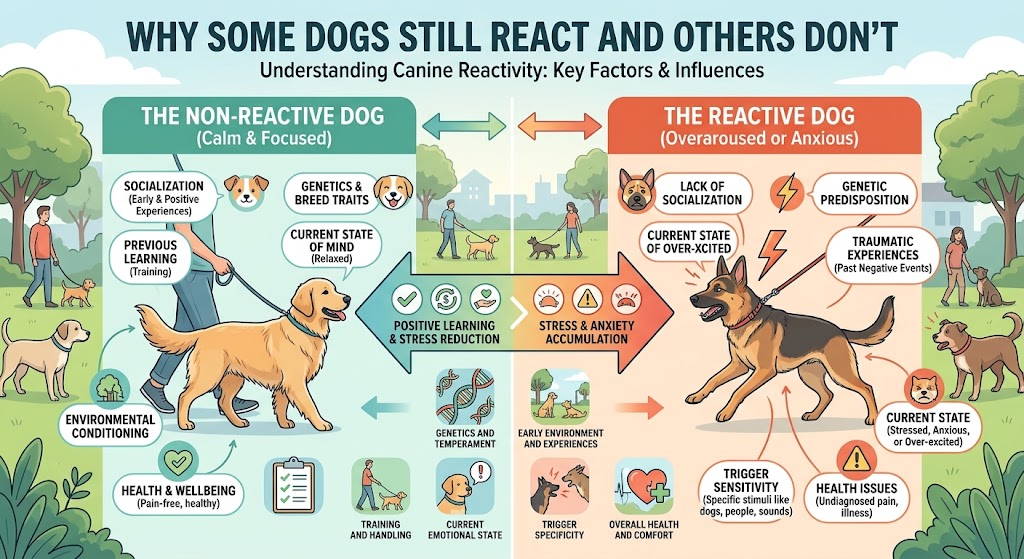
This is where the inconsistency comes from, and it isn’t really about whether the app “works” in a binary sense:
- Output volume matters more at the edge of a hardware’s range. A tone playing at the very top of what a speaker can produce is usually quieter and less clean than the same frequency from dedicated hardware, which means a dog has to be reasonably close and attentive to notice it.
- Individual hearing varies between dogs, just as it does between people. Breed, age, and ear shape all play a role in how sensitive a dog is to frequencies at the upper end of their range.
- Background noise competes with a weak signal. A faint, borderline-audible tone is far easier to miss in a room with a TV on or traffic outside than in a quiet space.
- Phone model matters a lot. Given how much speaker hardware varies between devices, the same app can genuinely perform differently on two different phones, not because of the app itself, but because of what each phone’s speaker can physically reproduce.
So Are These Apps Completely Useless?
Not necessarily, they’re just working with real physical limitations that most app descriptions don’t mention. A dog whistle app on a phone with a reasonably capable speaker, used at close range in a quiet environment, can plausibly produce a tone in the lower end of a dog’s ultrasonic hearing range. What it generally can’t do is replicate the volume, consistency, and clean output of a physical whistle built specifically for that frequency range, which is part of why results are so inconsistent across different owners, dogs, and devices.
If consistent results matter for actual training purposes, a physical whistle remains the more reliable tool, simply because it isn’t fighting against hardware designed for a completely different job.
Frequently Asked Questions
Can a phone speaker really produce a dog whistle sound? To a limited extent. Most phone speakers roll off sharply around 19 to 20 kHz, with some reaching usable output up to about 23 to 24 kHz under good conditions. That’s at the very bottom edge of where a real dog whistle’s range begins, so phones can produce a tone a dog may hear, but not with the volume or consistency of purpose-built whistle hardware.
Why does my dog react to the app sometimes but not other times? Because the tone is playing near the limit of what your phone’s speaker can cleanly produce, small differences in distance, background noise, and your dog’s attention at that moment can be enough to make the difference between a tone being noticed or missed entirely.
Is a physical dog whistle more reliable than an app? Generally, yes. A physical whistle is built specifically to resonate at ultrasonic frequencies efficiently, producing a stronger and more consistent tone than a phone speaker, which is designed primarily for human speech and music frequencies.
Do all phones perform the same with these apps? No. Speaker hardware varies significantly between phone models, so the same app can genuinely sound different, or be entirely inaudible to a dog, depending on which phone it’s played from.
Is it bad for my phone’s speaker to play these high frequencies? Occasional use for a dog whistle app is generally not a concern. Some research on ultrasonic signals has noted that speakers aren’t specifically designed for sustained output in that range, so it’s worth avoiding extended, repeated use at maximum volume, though brief training use isn’t the same as sustained ultrasonic transmission.
Want to try one anyway? Our Dog Whistle App is free to use, works best at close range in a quiet room, and your results may vary depending on your phone’s speaker. If you’re curious what your dog’s own vocalizations might mean, our Bark Translator looks at the problem from the opposite direction.