
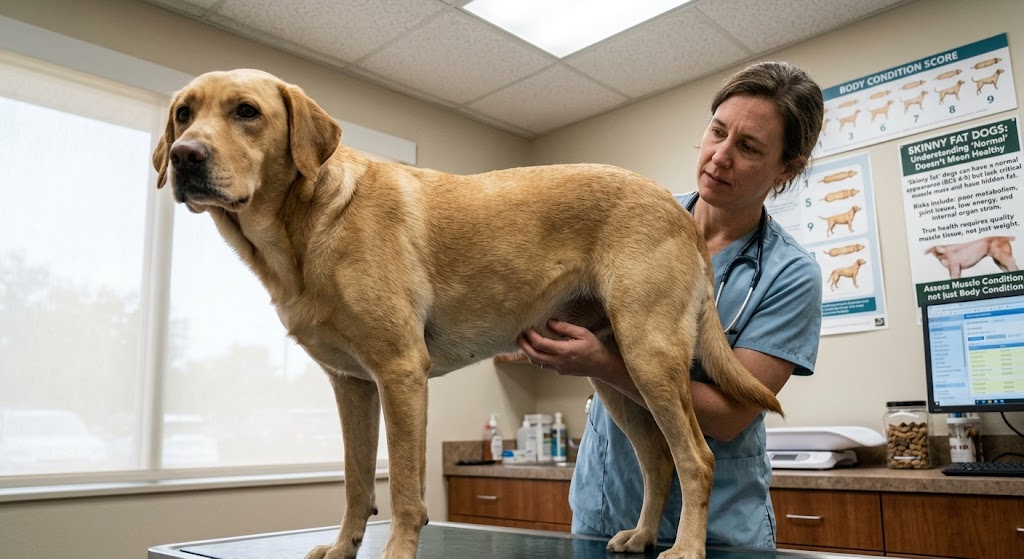
You check your dog’s ribs, look at their waist from above, and everything checks out. Body Condition Score sits right in the ideal range, 4 or 5 out of 9. By every standard chart, your dog looks fine.
But something still feels off. Maybe their back legs look thinner than they used to. Maybe they tire out faster on walks, or seem a little less steady going up the stairs. If your dog has a normal BCS but still doesn’t look or move like they used to, there’s a good chance the issue isn’t fat at all. It’s muscle.
This is what vets call a “skinny fat” dog, and it’s a pattern that a standard Body Condition Score check will almost always miss.
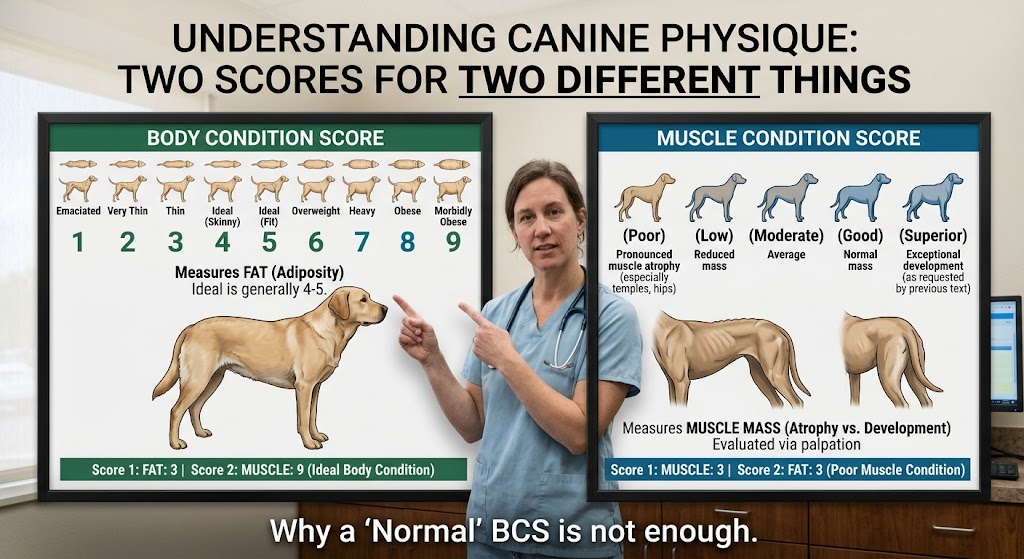
Two Different Scores That Measure Two Different Things
Body Condition Score measures one thing: fat cover. It tells you whether a dog is carrying too much, too little, or about the right amount of fat over their ribs, spine, and waist.
Muscle Condition Score (MCS) measures something else entirely: how much muscle mass a dog has over their spine, shoulder blades, and hips. A dog can sit right in the middle of the BCS scale, with a perfectly normal fat layer, while still losing significant muscle mass underneath. Fat and muscle are tracked completely separately, and one can decline without the other changing at all.
This is why “skinny fat” is the clearest way to describe the pattern: a dog’s overall shape and weight can look normal, while the muscle holding that frame together is quietly wasting away. BCS alone has no way to catch this, because fat cover can mask muscle loss almost completely from the outside.
Two Different Scores That Measure Two Different Things
Muscle wasting, known clinically as sarcopenia or cachexia depending on the cause, tends to show up in a few common situations:
- Senior dogs. Muscle mass naturally declines with age, often faster than most owners expect, even when a dog’s weight and appetite stay completely normal.
- Reduced activity. Arthritis, joint pain, or simply slowing down with age can lead to muscle loss in the hindquarters specifically, since those are the muscles used most for standing and climbing.
- Chronic illness. Conditions like kidney disease, heart disease, or cancer can trigger muscle breakdown even in a dog that’s eating normally and not losing weight.
- Low protein intake relative to needs. Older dogs in particular sometimes need more dietary protein to maintain muscle, not less, despite the old myth that senior dogs should be on low-protein diets.
In all of these cases, body fat can stay completely stable while muscle quietly declines underneath it. The dog’s weight on the scale might not move for months, and their BCS might read as a steady 5 out of 9 the entire time.
How to Actually Check for Muscle Loss
Muscle Condition Score is typically assessed on its own simple scale, separate from BCS:
- Normal muscle mass. Muscle is easily felt over the spine, shoulder blades, skull, and hips, with no obvious wasting in any one area.
- Mild muscle loss. Slight thinning is noticeable in one or more of those areas, most commonly over the spine or along the back legs.
- Moderate muscle loss. More pronounced wasting, with bony prominences becoming easier to see and feel.
- Severe muscle loss. Significant, often generalized wasting, with bones clearly visible under the skin regardless of fat cover.
To check for it at home, run your hands along your dog’s spine, shoulder blades, and the top of their hips, not their belly or ribs. Compare one side to the other, and compare how it feels now to how it felt a few months ago if you can recall. A dog who’s lost noticeable muscle along the spine or hindquarters, even while their waist and ribs look completely normal, is a dog worth bringing up with a vet, regardless of what their BCS says.
BCS and MCS Together: What the Combination Actually Means
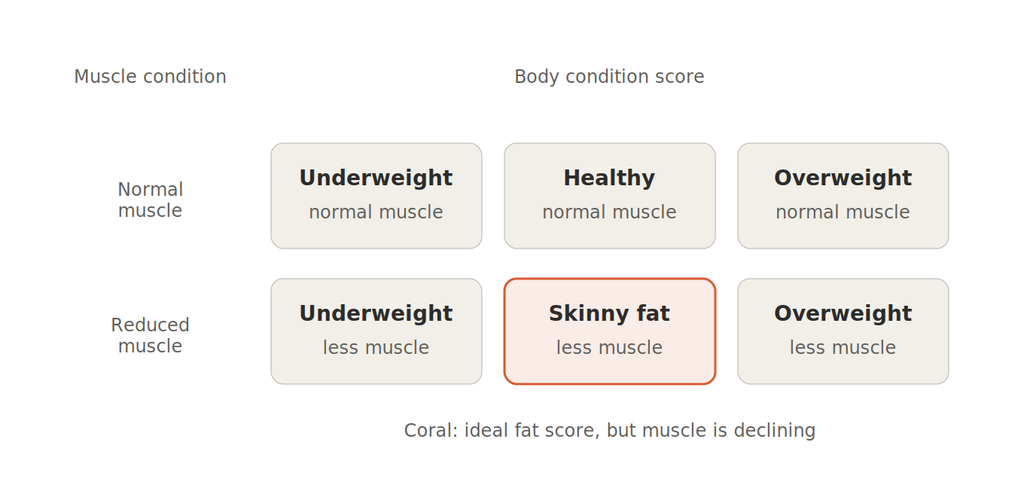
The key takeaway from this grid is the highlighted cell. A completely normal fat score combined with declining muscle is the pattern most owners never think to check for, simply because nothing about the dog’s weight or silhouette looks wrong at a glance. An underweight or overweight dog with declining muscle on top of that is a more serious combination still, usually pointing to more advanced illness rather than a simple diet fix.
Why This Matters More Than It Seems
Muscle isn’t just about appearance. It affects mobility, balance, metabolic health, and how well a dog’s body can recover from illness, injury, or surgery. A dog who’s losing muscle while their weight stays flat is often further along in that decline than their owner realizes, simply because nothing on the scale or the usual BCS check ever flagged it.
This is also why age-related weakness sometimes gets written off as “just getting older” when it’s actually a muscle loss pattern that could be addressed with diet and activity changes, especially if caught early.
What to Do If You Notice Muscle Loss
- Bring it up with your vet, especially if it’s a new or progressing change rather than something that’s always been part of your dog’s build.
- Review protein intake. Many senior dogs benefit from maintaining or even increasing dietary protein, not restricting it, to help preserve muscle mass.
- Keep activity consistent where possible. Gentle, regular movement helps maintain muscle even in dogs with some joint stiffness, though your vet can advise on what’s appropriate for your dog’s specific condition.
- Recheck both scores periodically, not just weight. A stable number on the scale can hide a lot of change happening underneath it.
Frequently Asked Questions
What is Muscle Condition Score in dogs? It’s a separate scale from Body Condition Score that measures muscle mass over the spine, shoulder blades, skull, and hips, rather than fat cover. A dog can have a normal BCS while still showing mild to severe muscle loss on an MCS check.
Can a dog have a normal body condition score but still be unhealthy? Yes. A dog can sit right in the ideal BCS range for fat cover while losing noticeable muscle mass underneath, a pattern commonly described as “skinny fat.” This is especially common in senior dogs and dogs with reduced activity or chronic illness.
My dog has skinny back legs but a normal looking body. What does that mean? Thinning specifically in the hindquarters while the rest of the body looks normal is a classic sign of muscle loss rather than weight loss. It’s worth a vet check, particularly if it’s a gradual change rather than how your dog has always looked.
Does a skinny fat dog need to lose weight? Not necessarily, and in some cases, no. The issue usually isn’t excess fat, it’s declining muscle. Putting a skinny fat dog on a restrictive diet without addressing the muscle loss can make the underlying problem worse, not better.
How is this different from a dog that’s just naturally lean or naturally heavy? A dog’s natural build affects both their BCS and MCS baseline, which is normal and not a concern on its own. What matters is a change over time, muscle that’s noticeably thinner than it used to be, rather than a dog’s consistent natural shape.
Already checked your dog’s Body Condition Score and want the fuller picture? Our Body Condition Score Checker is a good starting point for the fat side of the equation. If your dog is a senior, our Senior Dog Wellness Check-In covers more of the age-related changes worth tracking alongside muscle condition. And if diet is part of the conversation, our Dog Calorie Calculator can help make sure your dog’s intake matches their actual needs, not just their weight on the scale.