
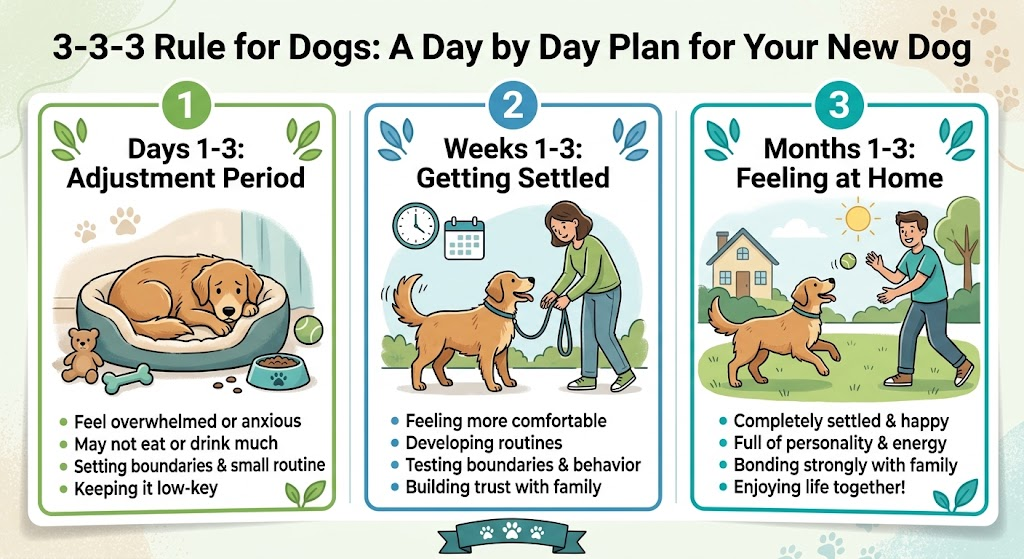
Short answer: The 3 3 3 rule for dogs is a rough guide to how a newly adopted dog adjusts. It says to expect about 3 days to decompress, 3 weeks to learn the routine, and 3 months to feel truly at home. It is a guideline, not a scientific rule. Some dogs settle faster and many take longer, especially shy dogs and dogs with a hard past. The useful part is not the numbers. It is knowing what to do at each stage and how to tell your dog is on track.
What is the 3 3 3 rule for dogs?
You may also see it called the 333 rule, the 3 days 3 weeks 3 months rule, or the rule of 3 for dogs. They all mean the same thing.
| Stage | What your dog may be feeling | What to do |
|---|---|---|
| First 3 days: decompress | Scared, overwhelmed, or shut down. Many dogs hide, sleep a lot, eat little, or have accidents | Keep things quiet and simple. One calm space, no visitors, no pressure, leashed potty trips |
| First 3 weeks: learn the routine | Starting to relax. Personality shows up, and so can testing, barking, chewing, or pulling | Keep meals, walks, and potty times steady. Start easy cues and reward calm behavior |
| First 3 months: feel at home | Trust is growing. Your dog knows the routine and acts more like itself | Add new experiences slowly, work on training, and build the bond |
Is the 3 3 3 rule real?
Shelters and rescue groups use it widely because it sets realistic expectations, but it comes from experience, not from a study. Age, history, breed, and personality all change the timeline. Treat the numbers as a rough map. If your dog is still nervous at week 4, nothing is wrong with your dog or with you.
The first 24 hours with an adopted dog
The first day sets the tone, and the best plan is a boring one.
- Before arrival: choose a quiet corner for a bed or crate, put away shoes and chewables, set up water, and make sure your dog’s ID tag and microchip details are ready.
- On arrival: go straight to the potty spot on a leash, let your dog sniff, then walk the leash through the home so the space feels less new.
- Food and water: offer fresh water and a small meal. Ask the shelter or foster what your dog was eating and keep that food for now.
- First night: keep the bed or crate close to where you sleep. Expect some restlessness, and keep the room calm.
- Skip for now: visitors, dog parks, a big bath, long outings, and photo sessions that crowd your dog.
The first 7 days: a simple plan
| Day | Focus |
|---|---|
| Day 1 | Arrive, potty, quiet space, water, small meal. Let your dog watch and sniff |
| Days 2 to 3 | Keep everything calm and the same. Short leashed walks near home. Watch appetite and potty habits |
| Days 4 to 5 | Settle into a fixed schedule for meals, walks, and potty. Practice very short separations of a few minutes |
| Days 6 to 7 | Book a vet visit if you have not already, reward calm moments, and let one calm person visit if your dog seems comfortable |
If your dog seems sick at any point, call your vet instead of waiting for the schedule.
Signs your rescue dog is settling in
- Eating regularly and finishing meals
- Sleeping deeply, even stretched out in the open
- Exploring the home without freezing or hiding
- Seeking your company, play, or attention on its own terms
- A loose, relaxed body and a softer face
- Bouncing back from a startling noise in a minute or two
- Settling quietly when you are home and when you leave for a short time
You will not see all of these at once. Look for the trend over weeks, not for a single good day.
The 12 week settling check
Most guides stop at “be patient.” A weekly check gives you something to measure. Once a week, answer five questions:
- Is my dog eating normally?
- Is my dog sleeping deeply and relaxed?
- Is my dog exploring without freezing?
- Does my dog seek contact or play on its own?
- Does my dog recover from a startle within a minute or two?
Count your yes answers. This is a home guide, not a clinical test.
| Yes answers | What it usually means |
|---|---|
| 4 to 5 | On track |
| 2 to 3 | Settling more slowly. Keep the routine steady and stay patient |
| 0 to 1 after the first 3 weeks | Talk to your vet and a trainer or behaviorist |
Compare week 4 with week 1, and week 12 with week 4. Progress that is slow but steady is still progress.
Normal adjustment or time to get help?
| What you see | What to do |
|---|---|
| Hiding, low appetite, or accidents in the first days | Usually normal. Keep things calm and call your vet if it lasts beyond about 2 days |
| Barking, chewing, or pulling around week 2 or 3 | Common as your dog tests the routine. Use consistent training. See the Dog Training Plan |
| Panic, howling, or destruction whenever you leave | Take the Separation Anxiety Barking Quiz and ask a trainer for help |
| Growling, snapping, or biting | Contact a certified trainer or behaviorist and your vet |
| Vomiting, diarrhea, or refusing food for more than a day or two | Call your vet |
| No sign of settling after several weeks | Talk to your vet and a trainer |
Not sure what your dog’s body is saying? The Dog Body Language Decoder helps you read stress and comfort signals.
Mistakes that slow settling
- Too many visitors too soon. A new dog needs quiet, not a welcome party.
- Rushing the introduction to your other dog. If you already have a dog at home, do not let the two meet freely on day one. Go slowly, and see how to get two dogs to get along for a step by step plan.
- Going to the dog park in week one. Wait until your dog knows you and the neighborhood.
- Too much freedom too fast. Give access to the house gradually.
- Punishing accidents or fear. It teaches your dog to hide the signs, not to relax.
- Changing the routine often. Predictable days are what help a dog feel safe.
- Skipping exercise. Calm daily walks help. The Dog Walking Time Calculator gives you a starting point.
What if your dog needs longer than 3 months?
That is common. Shy dogs, dogs with a rough history, and some seniors can take six months or more to fully relax. Keep the routine steady, keep training short and positive, and ask a trainer for help if progress stalls. Slow does not mean failing.
Still deciding whether now is the right time to adopt? The Dog Adoption Readiness Calculator can help you think it through before you bring a dog home.
FAQ
What is the 3 3 3 rule for dogs?
It is a rough guide for a newly adopted dog: about 3 days to decompress, 3 weeks to learn the routine, and 3 months to feel at home.
What is the 333 rule?
The same thing. The 333 rule, the 3 3 3 rule, and the rule of 3 for dogs all describe those three stages.
What is the 3 days 3 weeks 3 months rule for dogs?
It means the first 3 days are for decompressing, the first 3 weeks for learning the routine, and the first 3 months for feeling at home.
How do I help a rescue dog settle in?
Give a quiet space, keep a steady routine, skip visitors and crowded outings at first, reward calm behavior, and book a vet visit in the first week or two.
How do I know my rescue dog is settling in?
Look for steady eating, deep sleep, relaxed body language, exploring, and seeking contact. Judge the trend over weeks.
Is it normal for an adopted dog to not eat on the first day?
Many dogs eat little for a day or two. Call your vet if your dog refuses food for more than a day or two, or has vomiting or diarrhea.
Does the 3 3 3 rule apply to puppies?
Roughly, but puppies also need potty training and a vaccine plan. See the Puppy Shots Schedule.
How long does it take a rescue dog to adjust?
Often 3 weeks to 3 months, but some dogs need longer. Age, history, and personality all matter.
General information, not veterinary or behavior advice.