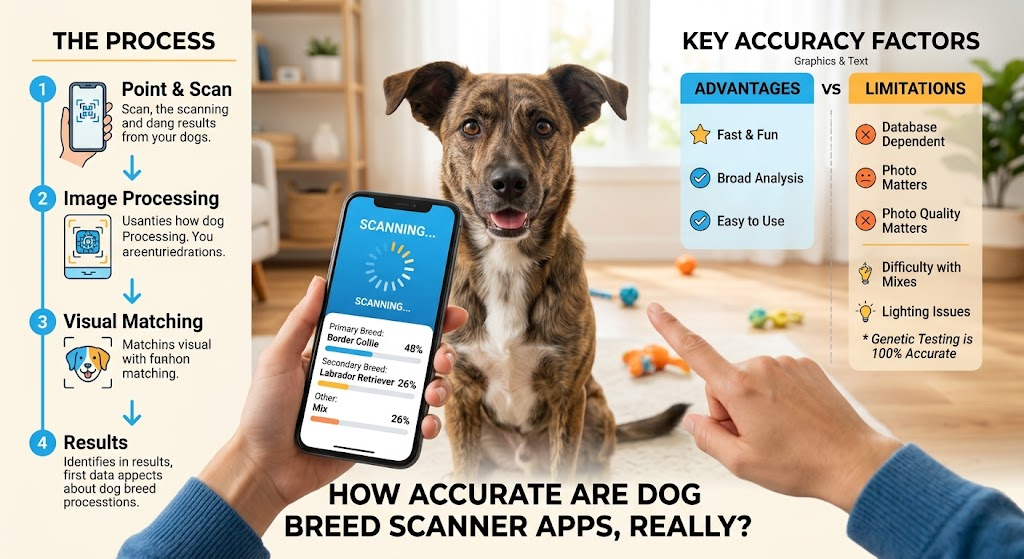
Point your phone camera at a dog, tap a button, and get an instant answer: “73% Labrador, 18% Boxer, 9% unknown.” It feels almost like magic, and the app store listings back it up with claims like “98% accurate” or “better than most human experts.” But almost none of those numbers come with an explanation of what they were actually tested against, and that detail matters more than the percentage itself.
Here’s what’s actually happening behind the scenes, and why the same app can nail one dog’s breed instantly and completely miss another’s.
How These Apps Actually Work
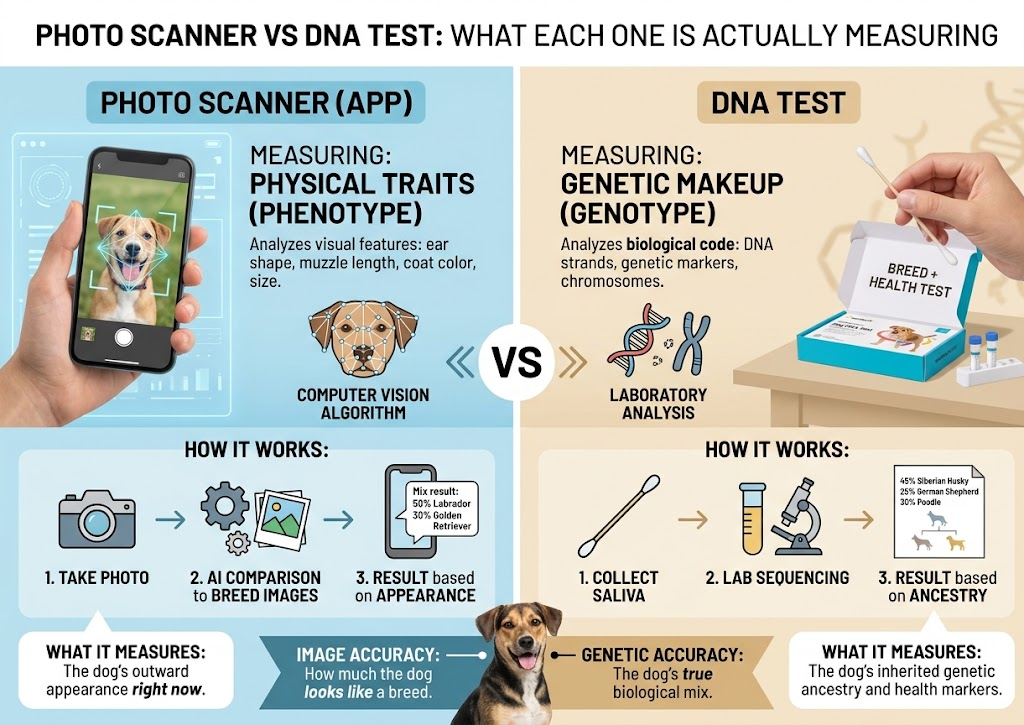
A photo-based breed scanner doesn’t look at DNA. It compares the shape, coloring, ear type, and proportions in your photo against a huge library of labeled dog photos, using a type of machine learning model trained to recognize visual patterns. In simple terms, it’s asking “which breed’s typical photos does this dog’s photo look most similar to?”
This is a fundamentally different question than a DNA test asks. A DNA test reads actual genetic markers and compares them against a reference database of breed genomes. A photo scanner is reading appearance, which is a much less direct signal, especially once a few generations of mixing have happened.
Why the Accuracy Numbers Are Misleading
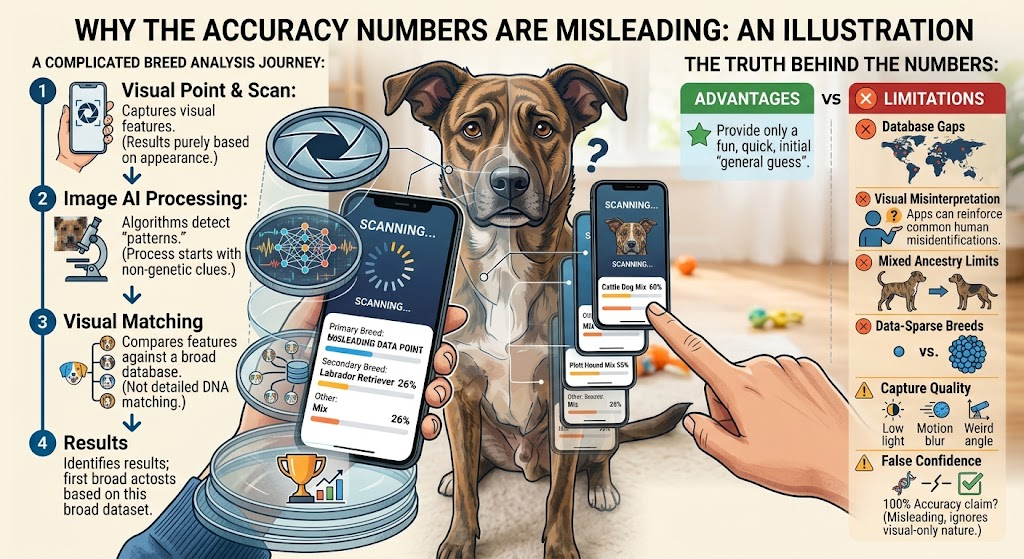
When an app claims “98% accuracy,” that number almost always comes from testing against a curated dataset, usually photos of dogs whose breed was already known and confirmed, often purebred dogs with textbook physical traits. That’s a reasonable way to benchmark a model during development, but it’s a very different test than “a random rescue dog with unknown ancestry photographed in someone’s backyard.”
This is the same gap seen across a lot of computer vision applications: a model that scores 98% on a clean, controlled test set can perform noticeably worse on messy, real-world input. The marketing number isn’t dishonest exactly, it’s just answering a narrower question than most users assume it’s answering.
Where These Apps Tend to Be Genuinely Reliable
Photo-based breed identification does reasonably well in a few specific situations:
- Purebred dogs with classic breed features. A Golden Retriever that looks like a Golden Retriever is the easiest case for any visual model.
- First-generation mixes of two visually distinct breeds. A Labrador and Poodle mix often still shows visible traits of both parents.
- Rough size and body-type categorization, even when the specific breed guess is off, the app is more likely to correctly identify general category (herding type, terrier type, etc.) than the exact breed.
Where They Tend to Fall Apart
- Multi-generation mixed breeds. A dog that’s a mix of a mix of a mix often doesn’t physically resemble any of its ancestor breeds clearly anymore, even though all of them are genetically present. The app is matching to what it visually sees, and visual traits don’t dilute predictably across generations the way genetics do.
- Rare or regional breeds underrepresented in training data. If a breed wasn’t well represented in the photos the model was trained on, it has little to match against and will often guess the closest visually similar breed it does know.
- Unusual photo angles, lighting, or a dog not facing the camera clearly. These apps are more sensitive to photo quality than most users expect, which is part of why the same dog can get different results from different photos.
- Puppies. A puppy’s proportions and coat often change significantly before adulthood, so a photo taken young may not reflect the breed traits a model is trained to recognize.
Photo Scanner vs DNA Test: What Each One Is Actually Measuring
| Photo Scanner App | DNA Test | |
|---|---|---|
| What it reads | Visual appearance in a photo | Genetic markers from a saliva or cheek swab |
| Best at | Purebred or clearly mixed dogs with visible traits | Any dog, regardless of appearance |
| Weak point | Multi-generation mixes, rare breeds, poor photos | Cost, turnaround time, database coverage for very rare breeds |
| Speed | Instant | Days to weeks |
| Cost | Usually free or very low cost | Typically $60-150+ |
Neither is inherently “better” across the board. A photo scanner is a reasonable, fast, free first guess, especially for a dog with visibly obvious traits. A DNA test is the more reliable choice when you need an actual answer, particularly for a rescue dog whose appearance doesn’t clearly point to anything specific.
How to Get the Most Useful Result From a Scanner App
- Use a clear, well-lit, full-body photo rather than a close-up of just the face. The model uses body proportions and coat pattern, not just facial features.
- Try more than one photo, ideally from different angles. If the results agree across photos, that’s a more trustworthy signal than a single scan.
- Treat the result as a starting point, not a verdict, especially for a dog with no visibly dominant breed traits. Use it alongside what you already know: size, behavior patterns, and where the dog was found.
- Expect lower reliability the more “blended” a dog looks. The less a dog visually resembles any single recognizable breed, the less confidently any photo-based tool can place it.
Frequently Asked Questions
Are dog breed scanner apps accurate? They’re reasonably accurate for purebred dogs and simple two-breed mixes with visible traits from both parents. Accuracy drops significantly for dogs with several generations of mixed ancestry, since the app is reading appearance rather than genetics.
Why did I get a different result from two different photos of the same dog? Photo angle, lighting, and how much of the body is visible all affect what the model can analyze. A clearer, full-body photo generally produces a more consistent result than a cropped face shot.
Is a breed scanner app as accurate as a DNA test? No, and the two tools aren’t really measuring the same thing. A DNA test reads genetic markers directly, while a photo scanner is estimating based on visual resemblance. For a dog with uncertain or heavily mixed ancestry, a DNA test will generally give a more reliable answer.
Why do app store listings claim such high accuracy percentages? Those numbers typically come from testing against a curated set of photos with already-known, often purebred, breeds. That’s a legitimate way to benchmark a model, but it doesn’t necessarily reflect how the app performs on an average mixed-breed rescue dog photographed in a backyard.
Can a breed scanner app accurately identify a puppy’s breed? It’s less reliable for puppies, since coat color, proportions, and other visual traits can change significantly between puppyhood and adulthood. A scan done later, once the dog is closer to full grown, tends to be more accurate.
Curious what our scanner makes of your dog? Try the Dog Scanner tool for a quick visual guess, or if you’re after a more playful take on breed matching based on personality and lifestyle rather than photos, our What Dog Breed Am I quiz looks at it from a completely different angle.